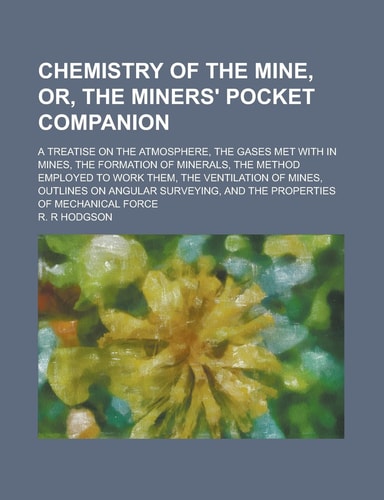
Chemistry of the Mine, Or, the Miners' Pocket Companion; a Treatise on the Atmosphere, the Gases Met with in Mines, the Formation of Minerals, the Met
0
0
As an Amazon Associate and affiliate partner, Menrva Books earns from qualifying purchases. Learn more
Author Description
This historic book may have numerous typos and missing text. Purchasers can usually download a free scanned copy of the original book (without typos) from the publisher. Not indexed. Not illustrated. 1881 edition. Excerpt:...and divide that product by the entire weight of air in the downcast, and the quotient will be the length of the motive column. If the quantity of air in the downcast weigh 1795.347 8 lbs., the depth of the pit measures 300 ft., and the difference of the weight of air in the two shafts be 243.85 lbs., what will be the length of the motive column 'P Example.--As 179534782300 22 243.85240.74 feet, length of the column required. 158. To find the length of the motive column from the depths of the shaft and the temperature of the upcast and downcast respectively, multiply the depth of the shaft in feet by the temperature of the upcast, minus the temperature of the downcast, and divide that product by the temperature of the upcast, plus the constant 459, and the quotient will be the length of the motive column in feet. The length of the motive column of a ventilating shaft is required, the downcast being 50 degs., and the upcast 130 degs., and the depth of the pit 300 feet. Example.--300 x g;;%=300 5"89=40.74 ft., the same as in the preceding example. 159. It will be seen from the two preceding examples that the column of air in the downcast would balance a column of air in the upcast, both pits being of the same depths and superficial area--40.74 feet higher than the length of its own column, so that the difference of density between the upcast and downcast current of air must be regarded as a vacuum equal in length to the motive column, and of the same superficial area as the upcast shaft. 160. A falling body rushes into a vacuum at a velocity equal to eight times the square root of the length of the vacuum (see 151), and the difference of density between the intake and return air, which represents a vacuum 40.74 ft. (see...
Menrva's Summary
THE THESIS
This historic text investigates the fundamental chemical and physical principles governing the atmosphere and mineral formation within mining environments, with a particular focus on ventilation dynamics.
THE SCOPE MAP
- Detailed calculations and explanations of atmospheric gases encountered in mines.
- Principles of mineral formation and identification relevant to mining.
- Formulas and examples for calculating ventilation motive column length based on air density, temperature, and shaft depth.
- Discussion of air density differences and their relation to vacuums in mine shafts.
- Historical context of mining science and safety practices from the late 19th century.
THE AUTHORITY PERSPECTIVE
This work is a historical technical manual, likely intended for mining engineers and geologists of the late 19th century. Its value lies in its primary source material, offering direct insight into the scientific understanding and practical calculations of the era. The inclusion of detailed examples suggests a pedagogical approach aimed at equipping practitioners with the necessary tools for mine safety and efficiency.
Page Count:
34
Publication Date:
2013-09-01
Publisher:
General Books LLC
ISBN-10:
1230018549
ISBN-13:
9781230018546
Science
History
Non-Fiction
Engineering
Community Tags
Similar Books












Reader Comments
Share Your Thoughts
No comments yet. Be the first to share your thoughts!