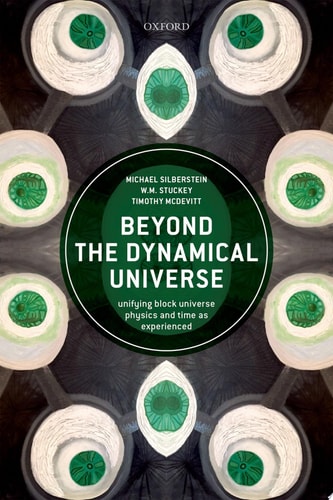
Beyond The Dynamic Universe: Unifying Block Universe Physics And Time As Experienced
0
0
As an Amazon Associate and affiliate partner, Menrva Books earns from qualifying purchases. Learn more
Author Description
Theoretical Physics And Foundations Of Physics Have Not Made Much Progress In The Last Few Decades. Whether We Are Talking About Unifying General Relativity And Quantum Field Theory (quantum Gravity), Explaining So-called Dark Energy And Dark Matter (cosmology), Or The Interpretation And Implications Of Quantum Mechanics And Relativity, There Is No Consensus In Sight. In Addition, Both Enterprises Are Deeply Puzzled About Various Facets Of Time Including Above All, Time As Experienced. The Authors Of This Work Argue That, Across The Board, This Impasse Is The Result Of The 'dynamical Universe Paradigm', The Idea That Reality Is Fundamentally Made Up Of Physical Entities That Evolve In Time From Some Initial State According To Dynamical Laws. Michael Silberstein, W.m. Stuckey, Timothy Mcdevitt. This Edition Previously Issued In Print: 2018. Includes Bibliographical References And Index.
Menrva's Summary
THE THESIS
This work investigates whether the prevailing 'dynamical universe paradigm' is the primary obstacle preventing progress in unifying general relativity and quantum field theory. The authors, Dr. Timothy McDevitt, Prof. Michael Silberstein, and W. M. Stuckey, draw upon their expertise in the foundations of physics to challenge the assumption that reality consists of entities evolving through time. They propose that shifting toward a block universe framework may resolve long-standing impasses in quantum gravity, cosmology, and the interpretation of experienced time.
THE SCOPE MAP
What You Will Find
- A critique of the dynamical universe paradigm in modern physics.
- A proposed framework for reconciling block universe physics with subjective temporal experience.
- Analysis of current impasses in quantum gravity and dark energy research.
Scope Limits
- The text does not provide a complete, experimentally verified theory of quantum gravity.
- It does not address biological or psychological models of time perception beyond their relation to physical theory.
THE AUTHORITY PERSPECTIVE
Experts in the philosophy of physics recognize this text as a rigorous challenge to standard ontological assumptions in theoretical physics. Readers frequently note the high level of technical density, making it most suitable for those with a strong background in the foundations of relativity and quantum mechanics.
Page Count:
0
Publication Date:
1900-01-01
Publisher:
Oxford University Press,
ISBN-10:
0191844853
ISBN-13:
9780191844850
Philosophy
Theoretical Physics
Cosmology
Philosophy of
Relativity
Physics
Community Tags
Similar Books