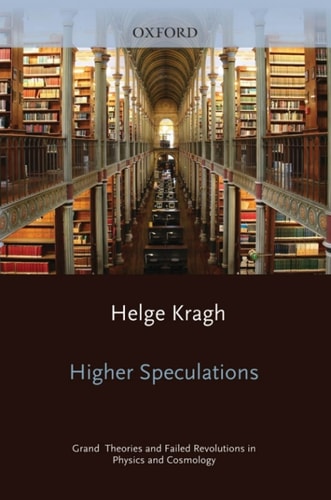
Higher Speculations: Grand Theories and Failed Revolutions in Physics and Cosmology
0
0
As an Amazon Associate and affiliate partner, Menrva Books earns from qualifying purchases. Learn more
Author Description
Throughout history, people have tried to construct 'theories of everything': highly ambitious attempts to understand nature in its totality. This account presents these theories in their historical contexts, from little-known hypotheses from the past to modern developments such as the theory of superstrings, the anthropic principle, and ideas of many universes, and uses them to problematize the limits of scientific knowledge. Do claims to theories of everything belong to science at all? Which are the epistemic standards on which an alleged scientific theory of the universe - or the multiverse - is to be judged? Such questions are currently being discussed by physicists and cosmologists, but rarely within a historical perspective. This book argues that these questions have a history and that knowledge of the historical development of 'higher speculations' may inform and qualify the current debate on the nature and limits of scientific explanation.
Menrva's Summary
THE THESIS
This book investigates the historical legitimacy and epistemic boundaries of 'theories of everything' within the fields of physics and cosmology. Prof. Helge Kragh, a historian of science, utilizes a broad historical framework to analyze ambitious attempts to unify physical laws. By contrasting past hypotheses with contemporary concepts like superstring theory and the multiverse, the author argues that historical context is necessary to evaluate the validity of modern speculative science.
THE SCOPE MAP
What You Will Find
- Historical analysis of speculative physical theories from the 19th century to the present
- Examination of the anthropic principle and multiverse hypotheses
- Philosophical inquiry into the demarcation between science and metaphysics
Scope Limits
- The text does not provide a technical manual for modern string theory
- It does not offer a definitive resolution to the current debates in theoretical physics
THE AUTHORITY PERSPECTIVE
Experts recognize this work as a significant contribution to the philosophy of science, particularly for its ability to ground abstract theoretical debates in historical reality. Readers frequently note the academic density of the prose, which is best suited for those with a background in the history of science or theoretical physics.
Page Count:
411
Publication Date:
2011-01-01
Publisher:
OUP Oxford
ISBN-10:
0191003344
ISBN-13:
9780191003349
Science
History
Earth Sciences
Philosophy of
Science History
Physics
Cosmology
Community Tags
Similar Books