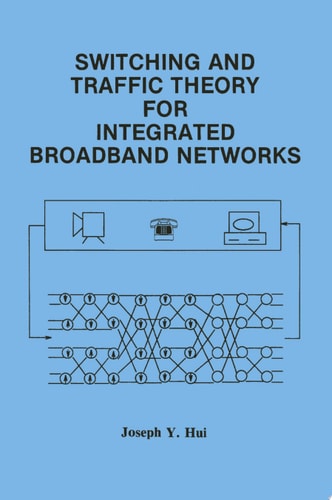
Switching and Traffic Theory for Integrated Broadband Networks
0
0
As an Amazon Associate and affiliate partner, Menrva Books earns from qualifying purchases. Learn more
Author Description
The rapid development of optical fiber transmission technology has created the possibility for constructing digital networks that are as ubiquitous as the current voice network but which can carry video, voice, and data in massive qlJantities. How and when such networks will evolve, who will pay for them, and what new applications will use them is anyone's guess. There appears to be no doubt, however, that the trend in telecommunication networks is toward far greater transmission speeds and toward greater heterogeneity in the requirements of different applications. This book treats some of the central problems involved in these networks of the future. First, how does one switch data at speeds orders of magnitude faster than that of existing networks? This problem has roots in both classical switching for telephony and in switching for packet networks. There are a number of new twists here, however. The first is that the high speeds necessitate the use of highly parallel processing and place a high premium on computational simplicity. The second is that the required data speeds and allowable delays of different applications differ by many orders of magnitude. The third is that it might be desirable to support both point to point applications and also applications involving broadcast from one source to a large set of destinations.
Menrva's Summary
THE THESIS
The book investigates the fundamental challenges in designing and implementing high-speed, integrated broadband networks capable of handling diverse applications like voice, video, and data. It addresses the critical problem of switching data at speeds far exceeding current capabilities, drawing upon principles from both classical telephony and packet network switching. The author highlights the necessity of highly parallel processing and computational simplicity due to these high speeds, alongside the vast differences in data speed and delay requirements across various applications. Furthermore, the text explores the potential for supporting both point-to-point and broadcast communication models within these future networks.
THE SCOPE MAP
- Analysis of switching architectures for high-speed digital networks.
- Exploration of computational simplicity in parallel processing for data transmission.
- Examination of heterogeneous application requirements (speed and delay).
- Discussion of support for both point-to-point and broadcast applications.
- Integration of principles from classical telephony and packet network switching.
- Consideration of the evolution and potential applications of future telecommunication networks.
THE AUTHORITY PERSPECTIVE
This book addresses the central problems in the evolution of telecommunication networks towards higher transmission speeds and greater application heterogeneity. The author, Joseph Y. Hui, focuses on the technical challenges of switching data at speeds orders of magnitude faster than existing networks. The text is structured to explore the roots of these problems in classical and packet switching, while introducing new considerations such as the need for parallel processing and computational simplicity. It also examines the diverse requirements of different applications and the potential for supporting various communication models.
Page Count:
347
Publication Date:
2012-12-06
Publisher:
Springer Science & Business Media
ISBN-10:
1461532647
ISBN-13:
9781461532644
Science & Technology
Non-Fiction
Telecommunications
Computer Networking
Community Tags
Other Editions(4)

Similar Books







Reader Comments
Share Your Thoughts
No comments yet. Be the first to share your thoughts!