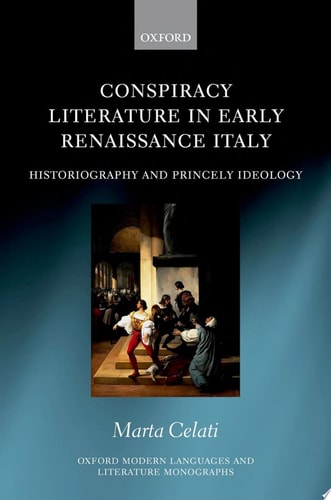
Conspiracy Literature in Early Renaissance Italy: Historiography and Princely Ideology
0
0
As an Amazon Associate and affiliate partner, Menrva Books earns from qualifying purchases. Learn more
Author Description
Cover -- Conspiracy Literature In Early Renaissance Italy: Historiography And Princely Ideology -- Copyright -- Dedication -- Acknowledgements -- Table Of Contents -- List Of Figures -- List Of Abbreviations -- Introduction -- I.1 Fifteenth-century Literature On Conspiracies: A Thematic And Political Genre -- I.2 The Prince In Literature On Plots: Power And Resistance In The Literary Realm -- I.3 The Classical Tradition And Crossovers Between Humanist Historiography And Political Literature -- I.4 Texts On Political Plots: A Multifaceted Corpus Chapter 1: Orazio Romano's Porcaria: Humanist Epic As A Vehicle For Papal-princely Ideology -- 1.1 Orazio Romano And The Composition Of The Poem -- 1.2 Stefano Porcari And The Conspiracy Against Nicholas V -- 1.3 Poetry As Literary Transposition Of The Topic Of Conspiracy -- 1.4 Classical Legacy And Latin Sources In The Porcaria -- 1.5 The 'papal Prince' And The Political Perspective In The Poem -- 1.6 The Eclectic Use Of The Classical Legacy And A New Political Symbolism -- Chapter 2: Leon Battista Alberti's Porcaria Coniuratio: The Epistle As An Unresolved Reflectionon The Political Plot 2.1 Alberti And The Porcaria Coniuratio -- 2.2 The Epistle As Historical Writing: The Conflation Of Literary Genres -- 2.3 Classical Theoretical Models: Alberti's View Of History -- 2.4 Thematic And Stylistic Models: A Sallustian Conspiracy -- 2.5 'eclectic Classicism' In Alberti's Language -- 2.6 The Rhetorical Construction Of An Unsettled Political Dialogue -- 2.7 The Disapproval Of Res Novae And The 'iciarchical' Image Of Power -- Chapter 3: Giovanni Pontano's De Bello Neapolitano: The Historia Of The Conspiracy In Political Theory 3.1 Pontano The Historian, The Royal Secretary, And The Theorist Of Politics And Historiography -- 3.2 Pontano's Models And The Development Of Political Historiography -- 3.3 Conspiracy, Obedience, And Kingship In Pontano's Political Theory -- 3.4 The Barons And The Crime Of Disobedience -- 3.5 The Loyal Noble
Menrva's Summary
THE THESIS
This work investigates how early Renaissance Italian authors utilized the theme of political conspiracy to articulate and reinforce princely ideology within humanist literature. Marta Celati, a scholar specializing in Renaissance political thought, examines how historical accounts and literary texts were crafted to legitimize power structures and define the boundaries of political obedience. By analyzing specific humanist writings, the author argues that these texts served as sophisticated tools for shaping the public perception of authority and dissent.
THE SCOPE MAP
What You Will Find
- Analysis of 15th-century humanist texts including Orazio Romano's Porcaria and Leon Battista Alberti's Porcaria Coniuratio.
- Examination of the intersection between classical Latin sources and contemporary political rhetoric.
- Discussion of Giovanni Pontano's historiographical approach to the Barons' War and royal authority.
Scope Limits
- The study focuses primarily on literary and historiographical representations rather than the factual reconstruction of the conspiracies themselves.
- The analysis is restricted to the specific ideological frameworks of the Italian Renaissance period.
THE AUTHORITY PERSPECTIVE
Scholars in the field of Renaissance studies identify this text as a rigorous examination of the intersection between political theory and literary production. Readers frequently note the academic density of the prose, which provides a specialized look at how humanist writers navigated the complexities of power and resistance.
Page Count:
0
Publication Date:
1900-01-01
Publisher:
Oxford University Press,
ISBN-10:
0191895997
ISBN-13:
9780191895999
History
Historiography
Italian History
Criticism history
Literary Criticism
In literature
Community Tags
Similar Books