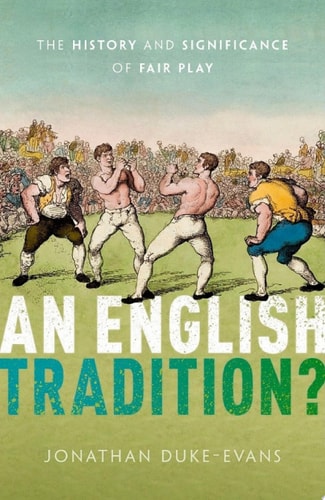
An English Tradition?: The History and Significance of Fair Play
0
0
As an Amazon Associate and affiliate partner, Menrva Books earns from qualifying purchases. Learn more
Author Description
For hundreds of years English people have claimed that fair play is at the core of their national identity. In this book Jonathan Duke-Evans explores the origins of the idea of fair play, tracing it back to the classical world and the Dark Ages, and finding its genesis deep within England's social structure. Charting its early development through both the tales of chivalry and the stories of popular legend, the book shows how fair play manifested itself in literature, the law, the Christian religion, and the family. It examines the way in which fair play was conceived during the ages of slavery and empire, and it proposes a new account of the birth of modern sport in the encounter between age-old popular games and the Victorian cult of amateurism. Taking in the Scottish, Irish, and Welsh manifestations of fair play, the book offers contrasts and comparisons from cultures all around the world, and suggests new perspectives on the relevance of fair play in the 21st century.
Menrva's Summary
THE THESIS
This book investigates the historical origins and cultural evolution of the concept of 'fair play' as a central pillar of English national identity. Jonathan Duke-Evans utilizes a multidisciplinary approach, drawing upon legal history, literature, religious texts, and social records to trace the development of this ethical framework. The author argues that fair play is not merely a modern sporting invention but a deeply rooted social construct that emerged from medieval chivalry, religious doctrine, and the complexities of the British imperial experience.
THE SCOPE MAP
What You Will Find
- Historical analysis of fair play from the classical world through the Victorian era.
- Examination of fair play within the contexts of slavery, empire, and domestic social structures.
- Comparative studies involving Scottish, Irish, and Welsh cultural interpretations.
- An account of the transition from traditional popular games to the Victorian cult of amateurism.
Scope Limits
- The text does not provide a comprehensive global history of sports ethics outside of the British and imperial context.
- It does not offer a prescriptive guide for modern ethical behavior in professional sports.
THE AUTHORITY PERSPECTIVE
Scholars and historians recognize this work as a thorough examination of the intersection between national identity and social ethics. Readers frequently note the academic density of the prose, which provides a rigorous foundation for understanding the cultural legacy of fair play.
Page Count:
365
Publication Date:
2022-01-01
Publisher:
Oxford University Press
ISBN-10:
0191953296
ISBN-13:
9780191953293
History
Social ethics
Sportsmanship
British History
National Characteristics British
Sociology
Sports History
Fairness
Society