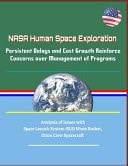
NASA Human Space Exploration: Persistent Delays and Cost Growth Reinforce Concerns Over Management of Programs - Analysis of Issues with Space Launch System (SLS) Moon Rocket, Orion Crew Spacecraft
0
0
As an Amazon Associate and affiliate partner, Menrva Books earns from qualifying purchases. Learn more
Author Description
This report from the GAO was issued in June 2019. NASA is undertaking a trio of closely related programs to continue human space exploration beyond low-Earth orbit. All three programs (SLS, Orion, and supporting ground systems) are working toward a launch readiness date of June 2020 for the first mission. Due to continued production and testing challenges, the National Aeronautics and Space Administration's (NASA) three related human spaceflight programs have encountered additional launch delays and cost growth. In November 2018, within one year of announcing an up to 19-month delay for the three programs- the Space Launch System (SLS) vehicle, the Orion spacecraft, and supporting ground systems-NASA senior leaders acknowledged the revised date of June 2020 is unlikely. Any issues uncovered during planned integration and testing may push the launch date as late as June 2021. Moreover, while NASA acknowledges about $1 billion in cost growth for the SLS program, it is understated. This is because NASA shifted some planned SLS scope to future missions but did not reduce the program's cost baseline accordingly. When GAO reduced the baseline to account for the reduced scope, the cost growth is about $1.8 billion.In addition, NASA's updated cost estimate for the Orion program reflects 5.6 percent cost growth. The estimate is not complete, however, as it assumes a launch date that is 7 months earlier than Orion's baseline launch date. If the program does not meet the earlier launch date, costs will increase further. Updating baselines to reflect current mission scope and providing complete cost estimates would provide NASA management and Congress with a more transparent assessment of where NASA is having difficulty controlling costs. NASA paid over $200 million in award fees from 2014-2018 related to contractor performance on the SLS stages and Orion spacecraft contracts. But the programs continue to fall behind schedule and overrun costs. Ongoing contract renegotiations w
Menrva's Summary
THE THESIS
The Space Launch System (SLS) and Orion programs face persistent delays and cost overruns, raising concerns about NASA's program management.
The Government Accountability Office (GAO) report, issued in June 2019, details significant challenges within NASA's human space exploration initiatives, specifically the SLS rocket and Orion spacecraft. These programs, intended for missions beyond low-Earth orbit, were targeting a June 2020 launch readiness date. However, ongoing production and testing issues have led to projected delays extending to June 2021 and substantial cost growth, with the GAO identifying approximately $1.8 billion in understated cost increases for SLS and further potential increases for Orion if its assumed launch date is not met. The report highlights that NASA's management and cost estimation practices, including the handling of award fees and the updating of baselines, obscure the true extent of these difficulties.
THE SCOPE MAP
- Analysis of persistent delays in NASA's human space exploration programs, specifically the Space Launch System (SLS) and Orion spacecraft.
- Examination of cost growth within the SLS and Orion programs, including understated figures and incomplete cost estimates.
- Discussion of NASA's program management practices, including the impact of scope changes and the awarding of contractor performance fees.
- Assessment of the projected launch readiness dates for the SLS and Orion, noting potential shifts from June 2020 to as late as June 2021.
- Review of the GAO's findings regarding NASA's reporting of cost growth and the need for more transparent assessments for management and Congress.
- Details on award fees paid to contractors for SLS stages and Orion spacecraft between 2014 and 2018, despite ongoing schedule and cost issues.
- The report's issuance date of June 2019 and its focus on programs targeting a June 2020 launch readiness.
THE AUTHORITY PERSPECTIVE
This GAO report serves as a critical assessment of NASA's management of its flagship human space exploration programs. The analysis points to systemic issues in cost control and schedule adherence, suggesting that NASA's reporting mechanisms may not fully capture the extent of program challenges. The document is intended to provide greater transparency for both NASA management and congressional oversight bodies regarding the financial and temporal realities of the SLS and Orion projects. The findings underscore the complexities inherent in large-scale aerospace development and the importance of accurate cost estimation and baseline management.
Page Count:
90
Publication Date:
2019-06-20
Publisher:
Amazon Digital Services LLC - KDP Print US
ISBN-10:
1075280761
ISBN-13:
9781075280764
Non-Fiction
Science & Technology
Government Reports
Aerospace
Community Tags
Similar Books







Reader Comments
Share Your Thoughts
No comments yet. Be the first to share your thoughts!