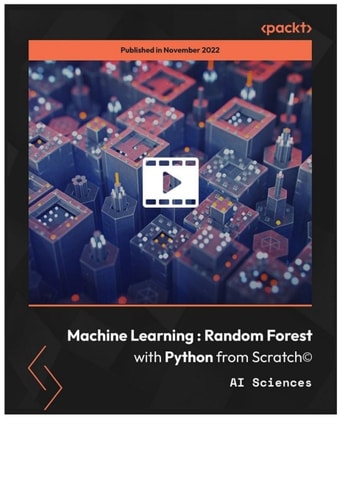
Machine Learning: Random Forest with Python from Scratch
0
0
As an Amazon Associate and affiliate partner, Menrva Books earns from qualifying purchases. Learn more
Author Description
Machine learning is designed to understand and build methods that 'learn' to leverage data to improve performance on a set of tasks. Machine learning algorithms are used in a plethora of applications in medicine, email filtering, speech recognition, and more, where it is challenging to develop conventional algorithms to perform tasks. The course begins with an introduction to machine learning concepts and explains the motivation for machine learning. The course teaches all major concepts about Python including variables, objects, strings, loops, decision-making statements, classes, and a small project to recap. You will learn to use the power of Python to train your machine and make predictions and implement the ML algorithm “Random Forest.” Use NumPy with Python for array handling, Pandas data frames for Excel files, and matplotlib for data visualization. You will learn to use Random Forest with sklearn, Matplotlib for Python plotting, and SciKit-Learn for Random Forest. Upon completion, you will Implement the structure of forest, impurity, information gain, partitions, leaf nodes, and decision nodes using Python and create a complete structure for Random Forest using Python to build one tree that lets you create an entire forest. You will write an accuracy calculator function and implement Random Forest on any dataset. All resources are available at: https://github.com/PacktPublishing/Machine-Learning-Random-Forest-with-Python-from-Scratch-
Menrva's Summary
THE THESIS
This book investigates the practical implementation of the Random Forest algorithm in machine learning using Python. The author, AI Sciences, aims to demystify machine learning by starting with fundamental concepts and the motivation behind its use. The text covers essential Python programming elements, including variables, loops, and object-oriented programming, before applying them to machine learning tasks. Readers will learn to build and train a Random Forest model from scratch, utilizing libraries such as NumPy, Pandas, and Matplotlib for data manipulation, analysis, and visualization.
THE SCOPE MAP
- Introduction to machine learning concepts and their applications.
- Comprehensive coverage of Python fundamentals relevant to data science.
- Implementation of NumPy for array handling and Pandas for data frames.
- Data visualization techniques using Matplotlib.
- Step-by-step construction of the Random Forest algorithm from basic principles.
- Understanding of forest structure, impurity, information gain, partitions, leaf nodes, and decision nodes.
- Creation of a complete Random Forest structure in Python.
- Development of an accuracy calculator function and application of Random Forest to diverse datasets.
THE AUTHORITY PERSPECTIVE
The book is presented as a practical guide for implementing the Random Forest algorithm in Python. Its approach focuses on building the algorithm from scratch, which suggests it is aimed at learners who want a deep understanding of the underlying mechanics rather than just using pre-built libraries. The inclusion of Python fundamentals and data visualization tools indicates a comprehensive learning experience for those new to machine learning or looking to solidify their foundational knowledge.
Page Count:
336
Publication Date:
2022-11-28
Publisher:
Packt Publishing
ISBN-10:
1803236809
ISBN-13:
9781803236803
Science
Non-Fiction
Data Science
Python
Machine Learning
Algorithms
Community Tags
Similar Books