Airflow Design Principles
0
0
As an Amazon Associate and affiliate partner, Menrva Books earns from qualifying purchases. Learn more
Author Description
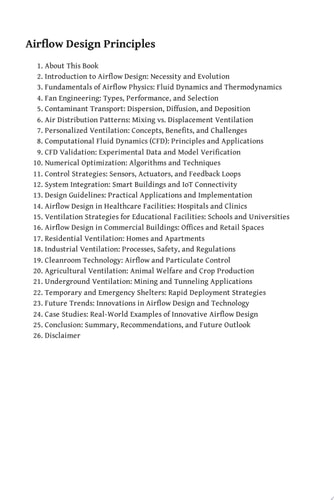
"Airflow Design Principles" offers a deep dive into the science of ventilation, focusing on optimizing airflow for superior contaminant removal and energy efficiency. The book highlights how crucial effective airflow is for maintaining healthy and productive indoor environments by preventing pollutant buildup. Did you know that inefficient ventilation systems not only compromise air quality but also lead to increased operational costs? This book uniquely integrates traditional design principles with advanced optimization techniques, advocating for performance-based strategies over conventional methods. Exploring the evolution of ventilation from basic natural methods to sophisticated mechanical systems, the book emphasizes a holistic, scientifically grounded approach. It uses real-world data, experimental studies, and CFD simulations to validate theoretical models, providing insights into complex air circulation patterns. From fluid dynamics to heat transfer, the principles governing airflow are thoroughly examined. The book is structured into three key sections: foundational principles, analysis of various ventilation strategies (like displacement or mixing ventilation), and advanced optimization techniques for minimizing energy consumption while maximizing contaminant removal. By integrating mechanical engineering, architectural design, and public health perspectives, "Airflow Design Principles" provides practical guidelines for diverse settings, from homes to industrial facilities, appealing to engineers, architects, and building scientists.
Menrva's Summary
THE THESIS
This book investigates how to optimize airflow for superior contaminant removal and energy efficiency in indoor environments. The author, Jack Patterson, draws upon traditional design principles and advanced optimization techniques to advocate for performance-based strategies in ventilation. The book examines the evolution of ventilation systems and emphasizes a holistic, scientifically grounded approach, using real-world data, experimental studies, and CFD simulations to explore complex air circulation patterns. It aims to provide practical guidelines for engineers, architects, and building scientists across various settings.
THE SCOPE MAP
- Foundational principles of airflow and fluid dynamics
- Analysis of various ventilation strategies (e.g., displacement, mixing ventilation)
- Advanced optimization techniques for minimizing energy consumption
- Maximizing contaminant removal through effective ventilation
- Integration of mechanical engineering, architectural design, and public health perspectives
- Real-world data, experimental studies, and CFD simulations
- Principles governing heat transfer in ventilation systems
THE AUTHORITY PERSPECTIVE
The book is structured to provide practical guidelines for diverse settings, integrating multiple scientific disciplines. Its focus on performance-based strategies over conventional methods suggests a forward-thinking approach to ventilation design. The use of empirical data and simulations indicates a rigorous, evidence-based methodology. This comprehensive approach is likely to appeal to professionals seeking to enhance indoor air quality and operational efficiency.
Page Count:
136
Publication Date:
2025-02-27
Publisher:
Publifye AS
ISBN-10:
8235204029
ISBN-13:
9788235204028
Non-Fiction
Science & Technology
HVAC
Building Science
Energy Efficiency
Community Tags
Similar Books