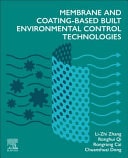
Membrane and Coating-Based Built Environmental Control Technologies
0
0
As an Amazon Associate and affiliate partner, Menrva Books earns from qualifying purchases. Learn more
Author Description
Membrane and Coating-Based Built Environmental Control Technologies addresses the urgent need for energy-saving and low-carbon solutions in the HVAC industry. With air conditioning accounting for a significant portion of energy consumption, this book explores technologies such as total heat recovery, air dehumidification, PM2.5 purification, and anti-frosting and anti-dewing. The utilization of membranes and coatings in these technologies has shown promising results in efficiency and indoor environment control. It provides a comprehensive overview of these advancements, including principles, material fabrications, performance analysis methods, and design guidelines. The book fills the gap in the market by offering an up-to-date reference that covers traditional and novel applications of membranes and coatings. It includes applications in areas like total heat recovery, air humidification and dehumidification, PM2.5 filtration, anti-frosting, and self-cleaning. It also provides mathematical models and numerical schemes to address heat and mass transfer challenges. Overall, it serves as a valuable resource for professionals, researchers, and students in the field of built environmental control technologies. Introduces novel membrane and coating technologies and materials for indoor air treatment Applies multi-scale multi-phase models to analyze and solve heat and mass transport in components, providing a comprehensive understanding of the processes involved Summarizes performance optimization guidelines and development directions, offering valuable insights for engineers in designing HVAC equipment
Menrva's Summary
THE THESIS
This book investigates the application of advanced membrane and coating technologies to create energy-efficient and low-carbon solutions for built environmental control systems. As air conditioning systems represent a significant energy drain, the authors explore how innovations in membranes and coatings can enhance total heat recovery, improve air dehumidification, purify PM2.5, and prevent frosting and dew formation. The work details the underlying principles, material fabrication processes, methods for performance analysis, and practical design guidelines for these emerging technologies. It aims to provide a comprehensive and up-to-date reference for professionals, researchers, and students in the field.
THE SCOPE MAP
- Principles of membrane and coating utilization in HVAC systems.
- Material fabrication techniques for advanced membranes and coatings.
- Performance analysis methods for environmental control technologies.
- Design guidelines for integrating membrane and coating solutions.
- Applications in total heat recovery.
- Applications in air humidification and dehumidification.
- Applications in PM2.5 filtration.
- Applications in anti-frosting and self-cleaning surfaces.
THE AUTHORITY PERSPECTIVE
The book addresses a critical need for energy-saving solutions in the HVAC industry, focusing on the innovative use of membranes and coatings. It is structured to provide a comprehensive overview, covering fundamental principles, material science, performance analysis, and design considerations. The inclusion of mathematical models and numerical schemes for heat and mass transfer suggests a rigorous, research-oriented approach. This resource is positioned as a valuable reference for engineers, researchers, and students seeking to advance built environmental control technologies.
Page Count:
450
Publication Date:
2025-09-01
Publisher:
Elsevier Science
ISBN-10:
0443341958
ISBN-13:
9780443341953
Non-Fiction
Science
Building Science
Energy Efficiency
HVAC
Community Tags
Similar Books