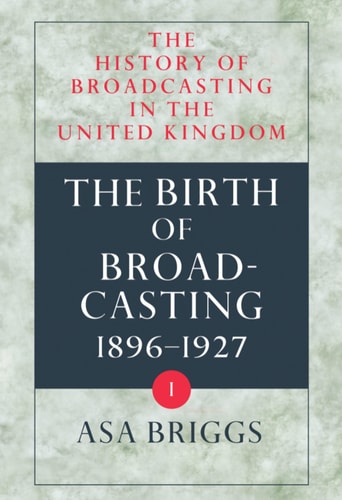
The History of Broadcasting in the United Kingdom: Volume I: The Birth of Broadcasting
0
0
As an Amazon Associate and affiliate partner, Menrva Books earns from qualifying purchases. Learn more
Author Description
This is the first part of a five-volume history of broadcasting in the UK. Together the volumes give an authoritative account of the rise of broadcasting in this country. Though naturally largely concerned with the BBC it does give a general history of broadcasting, not simply an institutional history of the BBC.The Birth of Broadcasting covers early amateur experiments in wireless telephony in America and in England, the pioneer days at Writtle in Essex and elsewhere, and the coming of organized broadcasting and its rapid growth during the first four years of the BBC's existence as a private Company before it became a public Corporation in January 1927. Briggs describes how and why the Company was formed, the scope of its activities and the reasons which led to its conversion from a business enterprise into a national institution.The issues raised between 1923 and 1927 remain pertinent today. The hard bargaining between the Post Office, private wireless interests, and the emergent British Broadcsting Company is discussed in illuminating details, together with the remarkable opposition with which the Company had to contend in its early days. Many sections of the opposition, including a powerful section of the press, seemed able to conceive of broadcasting only as competing with their own interests, never as complementing or enlarging them. One of the main themes of this volume is that of the gradual forging of the instruments of public control, and particular attention is paid to the Crawford Report (1926) from which the Corporation arose. During this period all the characteristics of the Corporation first appeared - particularly its reputation for publc service and impartiality.Briggs also examines the background of wireless as an invention and considers its impact on society. He has much to say about personalities and programmes as well as policies.
Menrva's Summary
THE THESIS
This volume investigates the foundational period of British broadcasting, specifically examining how the medium transitioned from amateur wireless experimentation to a structured national institution. Asa Briggs, a prominent historian, utilizes extensive archival records and institutional documentation to trace the evolution of the British Broadcasting Company between 1922 and 1927. The text argues that the formation of the BBC was not an inevitable outcome but the result of complex negotiations between private interests, the Post Office, and political entities. By analyzing these early years, the author establishes the framework for understanding the development of public service broadcasting in the United Kingdom.
THE SCOPE MAP
What You Will Find
- Detailed account of early wireless telephony experiments in America and England.
- Analysis of the transition from a private business enterprise to a public corporation.
- Examination of the 1926 Crawford Report and its influence on broadcasting policy.
- Discussion of the socio-political opposition faced by the early BBC from the press and private interests.
Scope Limits
- This volume is limited to the period ending in 1927 and does not cover the subsequent decades of broadcasting history.
- The focus remains primarily on the institutional and policy developments within the United Kingdom.
THE AUTHORITY PERSPECTIVE
Experts and historians recognize this work as the definitive, foundational study of the origins of British broadcasting. Readers frequently note the academic density of the prose, which provides a comprehensive and meticulous record of the era's administrative and social challenges.
Page Count:
436
Publication Date:
1995-05-25
Publisher:
Oxford University Press
ISBN-10:
0192129260
ISBN-13:
9780192129260
History
Communication
Broadcasting
Media Studies
Mass media
Technology
British History
Community Tags
Similar Books