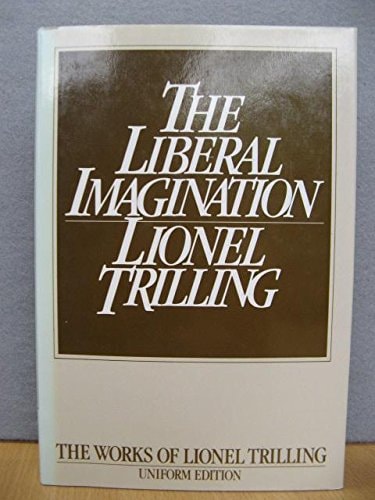
The Liberal Imagination: Essays on Literature and Society
0
0
As an Amazon Associate and affiliate partner, Menrva Books earns from qualifying purchases. Learn more
Author Description
The Liberal Imagination is one of the most admired and influential works of criticism of the last century, a work that is not only a masterpiece of literary criticism but an important statement about politics and society. Published in 1950, one of the chillier moments of the Cold War, Trilling’s essays examine the promise —and limits—of liberalism, challenging the complacency of a naïve liberal belief in rationality, progress, and the panaceas of economics and other social sciences, and asserting in their stead the irreducible complexity of human motivation and the tragic inevitability of tragedy. Only the imagination, Trilling argues, can give us access and insight into these realms and only the imagination can ground a reflective and considered, rather than programmatic and dogmatic, liberalism.Writing with acute intelligence about classics like Huckleberry Finn and the novels of Henry James and F. Scott Fitzgerald, but also on such varied matters as the Kinsey Report and money in the American imagination, Trilling presents a model of the critic as both part of and apart from his society, a defender of the reflective life that, in our ever more rationalized world, seems ever more necessary—and ever more remote.
Menrva's Summary
THE THESIS
Lionel Trilling investigates the core question of how the liberal imagination must reconcile the complexities of human motivation with the rigid, often dogmatic, frameworks of political and social progress. Trilling, a prominent mid-century American critic, utilizes his background in literature and cultural studies to argue that liberalism frequently suffers from a naive reliance on rationalism and social science. He posits that literature serves as a necessary corrective, providing the nuance and tragic awareness required to sustain a reflective political life in an increasingly technocratic society.
THE SCOPE MAP
What You Will Find
- Analysis of canonical American literature including works by Mark Twain, Henry James, and F. Scott Fitzgerald
- Critiques of mid-century social phenomena such as the Kinsey Report
- A philosophical framework for the role of the intellectual in a democratic society
Scope Limits
- The text does not provide a comprehensive history of liberal political theory
- It does not offer a prescriptive policy guide for modern governance
THE AUTHORITY PERSPECTIVE
Scholars and critics widely regard this collection as a foundational text for understanding the intersection of literary criticism and political thought in the twentieth century. Readers frequently note the intellectual density of the prose, which demands a high level of engagement with both the literary subjects and the underlying philosophical arguments.
Page Count:
304
Publication Date:
1978-01-01
Publisher:
Oxford University Press, 1981.
ISBN-10:
0192122185
ISBN-13:
9780192122186
American
Social Commentary
Essays
Political Theory
Literary Criticism
Community Tags
Other Editions(2)

Similar Books