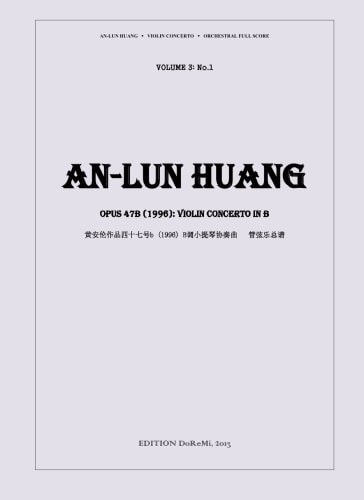
Violin Concerto in B
0
0
As an Amazon Associate and affiliate partner, Menrva Books earns from qualifying purchases. Learn more
Author Description
This concerto is the second part in a serial of three orchestra works the composer composed under the title "Symphonic Concert #2". The first part in this serial is an Overture and the third part is a Symphony. (The composer's earlier serial, Symphonic Concert #1, was written in the 1980's, also in the Overture/Concerto/Symphony format). This concerto was completed and world premiered by Lu Si-qing, whom the concerto dedicated to, in 1996. The music represents the composer's deep affection for the musical idiom of the Northern Chinese area ( although no folk tunes are incorporated into the music). This part of China is situated north of the Great Wall, where its music is a mix of both the ethnic Han and Mongolian, characterized by its unbounded and untamed rustic quality and the dramatic leaps in musical intervals.The first movement is full of vitality, written in sonata form. The main theme is in 5/4 and intermixed with a broad and slow second theme, and includes a brilliant musical section. The orchestral climax reflects the mountain ranges in China's north. The second movement shows the violin in a solid theme of freshness and depth. It closes in an unusual series of overtones, bring the movement to haunting end.The third movement uses the traditional wind/percussion style of China's North to bring a rhythmic theme to a climax. The main theme uses the mode of "Jiao", one of the five typical Chinese modes, then interchanges with the other four, which are in a same tone centre, they are "Gong", "Shang", "Zhi" and "Yu ".If the first note is C, the Chinese modes system will be line up in a pentatonic scale. Each note could be a tonic of a certain mode:C D E G AGong Shang Jiao Zhi Yu The theme is built on the Tonic B, and the concerto is in B, rather than B major or B minor. Chinese music has often been mistaken to be all pentatonic. The themes of this concerto use the seven-note scales. It creates an interesting harmonic quality that is uniquely Chinese. The compose
Menrva's Summary
THE THESIS
The Violin Concerto in B explores the composer's deep affection for the musical idiom of Northern China. The work, the second part of a three-part serial titled "Symphonic Concert #2," is dedicated to and was premiered by violinist Lu Si-qing in 1996. The music aims to capture the unbounded, untamed, and rustic quality of the region north of the Great Wall, characterized by dramatic leaps and a blend of Han and Mongolian influences, though it does not incorporate direct folk tunes. The concerto utilizes seven-note scales, creating a uniquely Chinese harmonic quality distinct from the common misconception of all Chinese music being pentatonic.
THE SCOPE MAP
- Analysis of the first movement: a vibrant sonata form with a 5/4 main theme, a broad second theme, and an orchestral climax reflecting Chinese mountain ranges.
- Description of the second movement: features a violin solo with a theme of freshness and depth, concluding with an unusual series of overtones.
- Examination of the third movement: employs traditional Northern Chinese wind/percussion styles with a rhythmic theme in the mode of 'Jiao' and other Chinese modes.
- Discussion of the concerto's tonal center: built on Tonic B, it is in B, not strictly B major or B minor.
- Explanation of the harmonic structure: utilizes seven-note scales to create a distinctively Chinese harmonic quality.
- Contextualization within the composer's serial works: positioned as the second part of "Symphonic Concert #2," following an Overture and preceding a Symphony.
THE AUTHORITY PERSPECTIVE
This work is presented as a significant orchestral composition by An-Lun Huang, dedicated to and premiered by renowned violinist Lu Si-qing. The description highlights the composer's intent to evoke the spirit of Northern China through musical idiom, structure, and harmonic language. The detailed breakdown of each movement suggests a work of considerable musical depth and complexity, appealing to those interested in contemporary classical music with a specific cultural influence. The concerto's unique use of seven-note scales and its place within a larger serial work indicate a sophisticated approach to composition.
Page Count:
120
Publication Date:
2013-07-03
Publisher:
CreateSpace Independent Publishing Platform
ISBN-10:
1490540814
ISBN-13:
9781490540818
Music
Non-Fiction
Concertos
Chinese Music
Community Tags
Similar Books