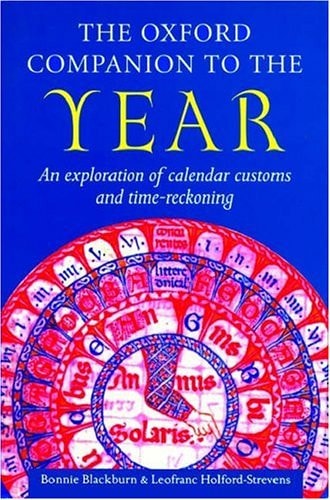
The Oxford Companion to the Year: An Exploration of Calendar Customs and Time-Reckoning
0
0
As an Amazon Associate and affiliate partner, Menrva Books earns from qualifying purchases. Learn more
Author Description
What are the halcyon days? On what date do the dog days begin? What is Hansel Monday? How do Chinese, Muslim, Mesoamerican, Jewish, and Babylonian calendars differ from Christian calendars? The answers to these and hundreds of other intriguing questions about the way humans have marked and measured time over the millennia can be found in The Oxford Companion to the Year.The desire to set aside certain periods of time to mark their significance is a transhistorical, transcultural phenomena. Virtually all cultures have marked special days or periods: the feast day of a saint, the celebration of a historical event, the turning of a season, a period of fasting, the birthday of an important historical figure. Around these days a rich body of traditions, beliefs, and superstitions have grown up, many of them only half-remembered today. Now, for the first time, Bonnie Blackburn and Leofranc Holford-Strevens combine this body of knowledge with a wide-ranging survey of calendars across cultures in an authoritative and engaging one-volume reference work. The first section of The Oxford Companion to the Year is a day-by-day survey of the calendar year, revealing the history, literature, legend, and lore associated with each season, month, and day. The second part provides a broader study of time-reckoning: historical and modern calendars, religious and civil, are explained, with handy tables for the conversion of dates between various systems and a helpful index to facilitate speedy reference.The Oxford Companion to the Year is a unique and uniquely delightful reference source, an indispensable aid for all historians and antiquarians, and a rich mine of information and inspiration for browsers.
Menrva's Summary
THE THESIS
This volume investigates the historical, religious, and cultural mechanisms humans have employed to measure time and assign significance to specific days throughout the year. Bonnie J. Blackburn and Leofranc Holford-Strevens synthesize extensive historical data and cross-cultural research to provide a comprehensive framework for understanding how diverse societies structure their calendars. The authors utilize a dual-structure approach, combining a chronological survey of lore with a technical analysis of time-reckoning systems.
THE SCOPE MAP
What You Will Find
- A day-by-day survey of calendar history, literature, and seasonal traditions.
- Technical explanations of various historical and modern calendar systems, including Chinese, Muslim, Jewish, and Mesoamerican.
- Conversion tables for navigating between different dating systems.
Scope Limits
- The text focuses primarily on historical and established cultural systems rather than speculative or future-oriented time-reckoning.
- It does not provide an exhaustive list of every localized folk tradition in existence.
THE AUTHORITY PERSPECTIVE
Experts and historians recognize this work as a comprehensive and authoritative reference for the study of chronometry and cultural history. Readers frequently note the academic density of the prose, which serves as a reliable resource for researchers and antiquarians alike.
Page Count:
937
Publication Date:
1999-12-01
Publisher:
Oxford University Press
ISBN-10:
0192142313
ISBN-13:
9780192142313
History
Folklore
Reference
Chronology
Calendars
Calendar
Community Tags
Similar Books