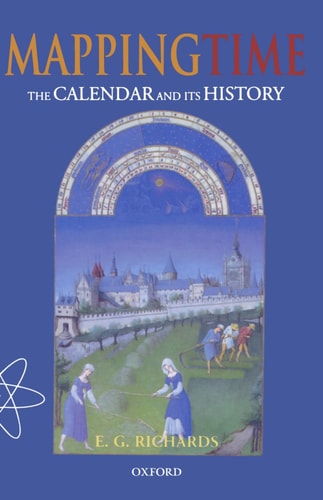
Mapping Time: The Calendar and Its History
0
0
As an Amazon Associate and affiliate partner, Menrva Books earns from qualifying purchases. Learn more
Author Description
This fascinating book draws together a wealth of diverse material on the much-trusted (and rarely disputed) phenomenon we know as the calendar. From the fundamentals of astronomy to the world's ancient time-keeping schemes, to the development of the modern-day calendar, to the precise calculation of when specific dates occur (as in how one arrives at the date for Easter Sunday), this is a skillful yet approachable discussion of the calendar from both the historical and contemporary perspectives. Readers will even learn how to perform experiments and calculations for themselves by using such basic techniques as stargazing and simple mathematics.
Menrva's Summary
THE THESIS
This book investigates the historical development, astronomical foundations, and mathematical mechanics of the calendar systems used by humanity. E. G. Richards, an expert in the field of chronology, synthesizes complex astronomical data with historical records to explain how civilizations have tracked time. The work provides a comprehensive framework for understanding both the ancient origins of time-keeping and the precise calculations required for modern calendar maintenance.
THE SCOPE MAP
What You Will Find
- Astronomical principles governing solar and lunar cycles
- Historical evolution of ancient time-keeping schemes
- Mathematical methodologies for calculating specific dates like Easter
- Practical exercises for readers to perform their own astronomical observations
Scope Limits
- Does not provide an exhaustive catalog of every minor regional calendar ever created
- Does not focus on the sociological impact of time-keeping beyond its functional utility
THE AUTHORITY PERSPECTIVE
Experts and readers alike identify this text as a highly accessible yet rigorous resource for those interested in the mechanics of time. The prose is noted for its clarity, making complex astronomical and mathematical concepts understandable for a general audience.
Page Count:
460
Publication Date:
2000-03-30
Publisher:
Oxford University Press
ISBN-10:
0192862057
ISBN-13:
9780192862051
History
Science
Chronology
Calendars
Calendar
Astronomy
Reference
Community Tags
Similar Books