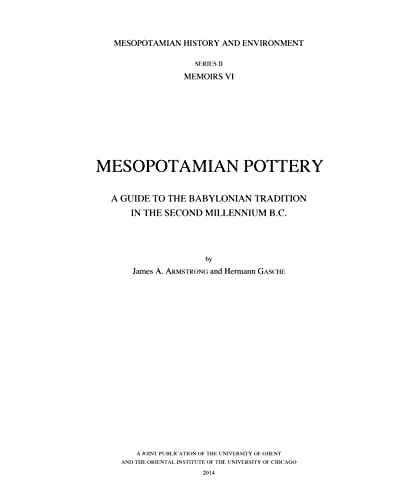
Mesopotamian Pottery: A Guide to the Babylonian Tradition in the Second Millennium B.C.
0
0
As an Amazon Associate and affiliate partner, Menrva Books earns from qualifying purchases. Learn more
Author Description
This volume presents the results of the long-term co-operation of archaeologists from the University of Ghent and the Oriental Institute of the University of Chicago to establish the ceramic chronology for Mesopotamia in the second millennium B.C. Drawing only upon pottery found in good context in well-conducted excavations, going back to the 1930s, but relying especially on the collaboration of other excavators who were working in southern Iraq from the 1960s onward, James Armstrong and Hermann Gasche, with the participation of cuneiformist Steven Cole and ceramic specialists Abraham Van As and Loe Jacobs, have created a typology of all major forms, showing the subtle changes that occurred in individual shapes through time at one site and at related sites. It also shows regional variations in shapes. Their graphic presention of the forms makes visible a centuries-long break in occupation of numerous sites in southern Iraq beginning in the time of Samsuiluna, the successor to Hammurabi of Babylon, and another break at the end of the millennium. There are detailed discussions of the forms and their geograhical distribution, as well as a treatment of the historical implications of the evidence.
Menrva's Summary
THE THESIS
This volume establishes the ceramic chronology for Mesopotamia during the second millennium B.C.
The book is the result of a long-term collaboration between archaeologists from the University of Ghent and the Oriental Institute of the University of Chicago, building upon excavations dating back to the 1930s and extensive collaboration with other excavators in southern Iraq from the 1960s onward. Authors James Armstrong and Hermann Gasche, with contributions from cuneiformist Steven Cole and ceramic specialists Abraham Van As and Loe Jacobs, present a detailed typology of major pottery forms, illustrating subtle temporal changes and regional variations. The graphic presentation highlights significant breaks in site occupation, particularly after the reign of Samsuiluna and at the millennium's close, offering insights into historical implications.
THE SCOPE MAP
- A detailed typology of major Mesopotamian pottery forms from the second millennium B.C.
- Analysis of subtle changes in individual shapes over time at single and related sites.
- Identification of regional variations in pottery shapes.
- Graphic presentation of forms to visualize chronological shifts.
- Discussion of historical implications derived from ceramic evidence.
- Documentation of breaks in site occupation during specific periods.
THE AUTHORITY PERSPECTIVE
This scholarly work is a significant contribution to the understanding of Mesopotamian archaeology and the Babylonian tradition. The detailed typological analysis, grounded in well-excavated contexts, provides a robust framework for dating and understanding cultural changes. The collaboration of specialists in archaeology, cuneiform studies, and ceramics ensures a comprehensive and authoritative perspective. The book's meticulous presentation of forms and historical implications makes it an invaluable resource for researchers in the field.
Page Count:
102
Publication Date:
2014-01-01
Publisher:
University of Ghent
ISBN-10:
1614910189
ISBN-13:
9781614910183
History
Non-Fiction
Archaeology
Mesopotamia
Pottery
Community Tags
Similar Books