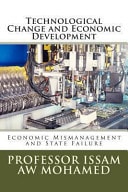
Technological Change and Economic Development: Economic Mismanagement and State Failure
0
0
As an Amazon Associate and affiliate partner, Menrva Books earns from qualifying purchases. Learn more
Author Description
The role of technology in economic development is critical, pervasive, and indispensable. In today's world, the degree of a country's development or underdevelopment depends critically on the extent to which technology has been harnessed to facilitate the production of goods and services in agriculture, industry, commerce, and professional activities. This at least implies a systematic approach to control of production through labor-saving techniques and a sophistication of communications, transportation network, etc. However, the key issues of the role of technological change in the development process have received vary scanty attention by the policy makers in the developing countries. Furthermore, the development of science and technology in the poor countries are implicitly taken usually by default since for a long time those nations did not seriously direct their attention to the formulation and implementation of explicit technological policies let alone devote adequate resources to research and development (R and D) and other science and technology activities. The science and technology scene in the majority of developing countries is accordingly dominated by the views and actions of aid donors, foreign academics and multiplicity of foreign consultants. Technology, which is now science-based continues to develop at such an exponential rate that its role in the development process has become complex. In spite of this complexity, the level of science and technological progress in a country is now acknowledged to be a major determinant of that country's standard of living and, in fact, political and military power. The poor countries, especially in Africa, still continue to grapple with pressing development problems by prescribing short-term macroeconomic solutions which over the years have proved ineffective. Poverty rates continue to feed on itself. Without adequate resources to implement programs and projects, these poor countries continue to rely mainly on dw
Menrva's Summary
THE THESIS
Technological advancement is the linchpin of economic development, yet developing nations often fail to harness its potential due to mismanagement and a lack of explicit policy. The book examines the critical, pervasive, and indispensable role of technology in a country's development, arguing that the degree of progress is directly tied to how effectively technology is integrated into agriculture, industry, commerce, and professional activities. It highlights the neglect of these issues by policymakers in developing countries, who often default to foreign-influenced approaches rather than formulating and implementing their own technological policies. The text posits that despite the complex, science-based, and exponentially growing nature of technology, its progress is a major determinant of a nation's standard of living and global power.
THE SCOPE MAP
- The indispensable role of technology in economic development across various sectors.
- Analysis of economic mismanagement and state failure in developing countries.
- The impact of technological change on a nation's standard of living and political power.
- Critique of short-term macroeconomic solutions applied in developing nations, particularly in Africa.
- The dominance of foreign aid donors, academics, and consultants in shaping science and technology in poorer countries.
- The necessity of explicit technological policies and investment in Research and Development (R&D).
THE AUTHORITY PERSPECTIVE
The book addresses the critical intersection of technological change and economic development, focusing on the challenges faced by developing nations. It critiques the prevalent economic mismanagement and state failure that hinder the effective adoption and utilization of technology. The text suggests that a lack of explicit policy and investment in R&D, coupled with reliance on external influences, perpetuates underdevelopment. Ultimately, the work underscores that a country's standard of living and global standing are intrinsically linked to its progress in science and technology.
Page Count:
160
Publication Date:
2012-12-07
Publisher:
CreateSpace Independent Publishing Platform
ISBN-10:
1481174150
ISBN-13:
9781481174152
Non-Fiction
Economics
Science & Technology
Community Tags
Similar Books














Reader Comments
Share Your Thoughts
No comments yet. Be the first to share your thoughts!