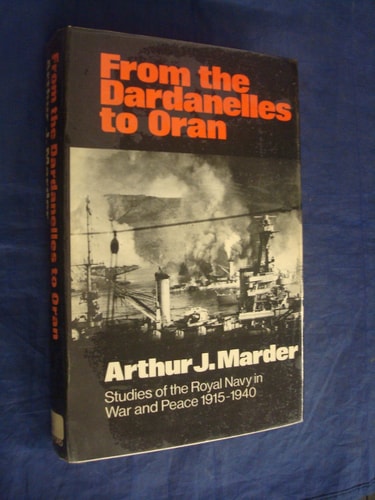
From the Dardanelles to Oran: Studies of the Royal Navy in War and Peace 1915-1940
0
0
As an Amazon Associate and affiliate partner, Menrva Books earns from qualifying purchases. Learn more
Author Description
This collection of thought-provoking essays by arguably the 20th century's greatest naval historian was first published in 1974, but their continuing relevance fully justifies this reprint. It opens with a stimulating reappraisal of the naval attack on the Dardanelles, the success of which would have made the disastrous Gallipoli land campaign that followed completely unnecessary. Marder identifies a number of relatively minor issues that made a failure of what was in reality a great strategic opportunity to shorten the war. Other chapters cover what the Royal Navy did and did not learn from the Great War, and Churchill's controversial time at the Admiralty before he became Prime minister in 1940, while Marder's analysis of the inter-war Ethiopian Crisis asking whether military aggression can be countered by sanctions has powerful echoes of current political concerns. The final essay looks at one of the most contentious episodes of the Second World War, the British pre-emptive strike on the fleet of their one-time allies at Oran after the French surrender in 1940.Because Marder's view of history emphasises the human dimension over abstract forces, his work is always approachable in style and of as much interest to the layman as the professional historian. This book is no exception.
Menrva's Summary
THE THESIS
This collection of essays investigates the strategic decisions, institutional learning, and political challenges faced by the Royal Navy between 1915 and 1940. Arthur J. Marder, a preeminent naval historian, utilizes archival research and primary source analysis to evaluate critical moments such as the Dardanelles campaign, inter-war policy, and the strike at Oran. The work argues that human leadership and specific tactical choices often outweighed abstract geopolitical forces in determining the outcomes of these naval engagements.
THE SCOPE MAP
What You Will Find
- Analysis of the Dardanelles naval campaign and its strategic implications for the Gallipoli land operations.
- Examination of institutional lessons learned by the Royal Navy following the Great War.
- Evaluation of Winston Churchill's tenure at the Admiralty.
- Case study of the Ethiopian Crisis regarding the efficacy of sanctions against military aggression.
- Historical review of the British pre-emptive strike on the French fleet at Oran in 1940.
Scope Limits
- The text focuses specifically on the Royal Navy and does not provide a comprehensive history of the entire Second World War.
- The analysis is limited to the period between 1915 and 1940 and does not cover naval developments post-1940.
THE AUTHORITY PERSPECTIVE
Experts recognize Marder as a foundational figure in naval historiography, frequently citing his ability to synthesize complex strategic data into accessible prose. Readers note that while the text maintains high academic standards, its focus on the human element makes it suitable for both professional historians and interested laypeople.
Page Count:
301
Publication Date:
1974-11-01
Publisher:
Oxford University Press
ISBN-10:
0192158023
ISBN-13:
9780192158024
History
Great Britain
Naval history
20th Century
Essays
Military History
Community Tags
Similar Books