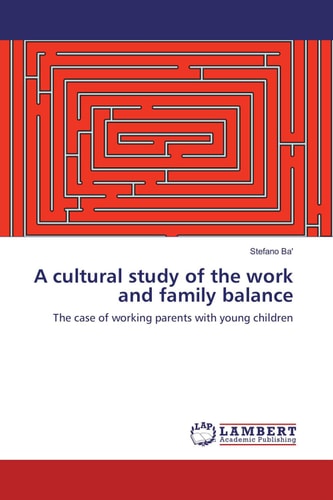
A Cultural Study of the Work and Family Balance: The Case of Working Parents with Young Children
0
0
As an Amazon Associate and affiliate partner, Menrva Books earns from qualifying purchases. Learn more
Author Description
This book is about the cultural aspects of the work-family balance. Most of the publications in this field consider the 'time' and 'energy' that parents dedicate to one domain or the other as the main factors in explaining the dilemmas that parents face in balancing these spheres. Conversely, this study considers how working parents use emotional and material resources in managing their various commitments and analyses how parents attach different symbolic values (through family's meals, play time with children, job gratification etc.) to the domains of daily life. These emotional and material resources are highly dependant from parents' occupational level. Indeed, this research finds that the possibility of managing work-family balance is connected to job status, autonomy and power dynamics and such a relation reflects different patterns of the work-family interface within the middle-class respondents to this study. Here is where this research fills a gap in the literature, as there is little research on the symbolic level of work-family balance and on how this symbolic level is continuously framed by work conditions and parental obligations.
Menrva's Summary
THE THESIS
This study investigates the symbolic and resource-based dimensions of work-family balance among working parents with young children. Unlike much existing literature that focuses on time and energy, this research examines how parents leverage emotional and material resources, and the symbolic value they assign to daily life domains such as family meals and job gratification. The findings reveal a strong connection between a parent's occupational level, including job status, autonomy, and power dynamics, and their ability to manage work-family balance. This research specifically addresses a gap in the literature by exploring the symbolic level of work-family balance and its continuous framing by work conditions and parental obligations, particularly within the middle-class respondents studied.
THE SCOPE MAP
- Analysis of emotional and material resources used by working parents.
- Examination of symbolic values attached to daily life domains (family meals, playtime, job gratification).
- Connection between occupational level (job status, autonomy, power dynamics) and work-family balance management.
- Focus on the middle-class respondents within the study.
- Exploration of the symbolic level of work-family balance.
- Investigation of how work conditions and parental obligations frame the work-family interface.
THE AUTHORITY PERSPECTIVE
This study offers a novel perspective on work-family balance by shifting the focus from time and energy to the management of emotional and material resources and the symbolic values parents assign to different life domains. The research highlights the significant influence of occupational status and workplace dynamics on a parent's ability to achieve balance, particularly within the middle class. By examining the symbolic level of this balance, the work fills a notable gap in existing literature.
Page Count:
292
Publication Date:
2017-09-26
Publisher:
LAP LAMBERT Academic Publishing
ISBN-10:
3330345322
ISBN-13:
9783330345324
Non-Fiction
Psychology
Parenting
Family Studies
Middle class
Work Life Balance
Sociology
Community Tags
Similar Books