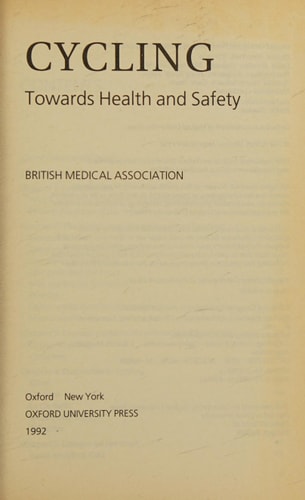
Cycling: Towards Health and Safety
0
0
As an Amazon Associate and affiliate partner, Menrva Books earns from qualifying purchases. Learn more
Author Description
In recent years, public health campaigns advocating regular exercise have tended to overlook one of the simplest and most effective ways of getting fit - cycling. The benefits are not simply limited to shaping up. Riding to work or school means you can exercise as part of the daily routine. Cycling also has much to contribute to the wider public health. Getting on your bike can help reduce air and noise pollution and the increasingly alarming problem of urban congestion. However, the fitness and environmental advantages are frequently overshadowed by fears of injury on our often dangerous roads. Cyclists' concerns are also poorly addressed in current transport policy - a situation this book seeks to redress. The book should be of interest to the general reader, those working in health promotion and education, policy makers and pressure groups.
Menrva's Summary
THE THESIS
This book investigates the intersection of public health, environmental sustainability, and transport policy to argue for the integration of cycling into daily life and urban infrastructure. The British Medical Association presents a comprehensive analysis of how cycling serves as a viable solution to sedentary lifestyles and urban congestion. By evaluating the current state of road safety and transport policy, the authors provide a framework for prioritizing cyclist welfare to improve community health outcomes.
THE SCOPE MAP
What You Will Find
- Analysis of the physiological benefits of regular cycling as a daily routine
- Evaluation of the environmental impact of cycling on air and noise pollution
- Assessment of current transport policies and their failure to protect cyclists
Scope Limits
- Does not provide technical engineering specifications for bicycle lane construction
- Does not offer a personal training manual or specific fitness coaching plans
THE AUTHORITY PERSPECTIVE
Experts and public health professionals recognize this text as a foundational document for advocating cycling as a legitimate public health intervention. Readers frequently note that the prose is accessible to both policy makers and the general public while maintaining a rigorous focus on safety and systemic reform.
Page Count:
159
Publication Date:
1992-01-01
Publisher:
Oxford Univ Pr
ISBN-10:
0192177834
ISBN-13:
9780192177834
Health
Transportation
urban planning
Fitness
Public Policy
Cycling
Community Tags
Similar Books