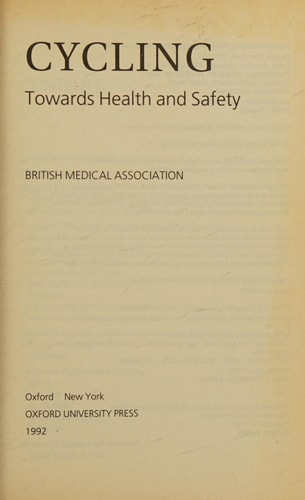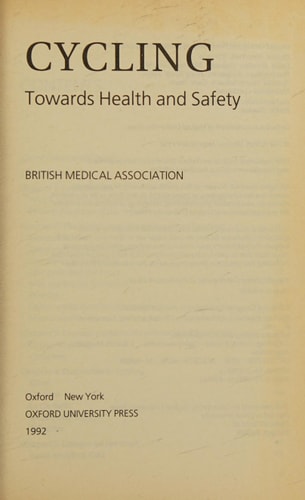
Cycling Towards Health & Safety
0
0
As an Amazon Associate and affiliate partner, Menrva Books earns from qualifying purchases. Learn more
Author Description
In recent years, public health campaigns advocating regular exercise have tended to overlook one of the simplest and most effective ways of getting fit - cycling. The benefits are not simply limited to shaping up. Riding to work or school means you can exercise as part of the daily routine. Cycling also has much to contribute to the wider public health. Getting on your bike can help reduce air and noise pollution and the increasingly alarming problem of urban congestion. However, the fitness and environmental advantages are frequently overshadowed by fears of injury on our often dangerous roads. Cyclists' concerns are also poorly addressed in current transport policy - a situation this book seeks to redress. The book should be of interest to the general reader, those working in health promotion and education, policy makers and pressure groups.
Menrva's Summary
THE THESIS
This book investigates the intersection of public health, environmental sustainability, and urban transport policy, arguing that cycling is an underutilized tool for improving both individual fitness and societal well-being. The British Medical Association presents a comprehensive framework that connects physical activity to broader infrastructure needs. By analyzing the barriers to cycling, the authors advocate for policy changes that prioritize safety and accessibility to encourage widespread adoption of this mode of transport.
THE SCOPE MAP
What You Will Find
- Analysis of the physiological benefits of regular cycling as a daily routine.
- Evaluation of the environmental impact of cycling on air quality and urban congestion.
- Examination of current transport policies and their failure to adequately protect cyclists.
Scope Limits
- The text does not provide technical engineering specifications for bicycle lane construction.
- It does not offer a personal training manual for competitive cycling.
THE AUTHORITY PERSPECTIVE
Experts in public health and urban planning recognize this work as a foundational text for understanding the societal barriers to active transport. Readers frequently note the clarity of the arguments, which effectively bridge the gap between medical advocacy and practical policy implementation.
Page Count:
168
Publication Date:
1992-04-16
Publisher:
BMJ Books
ISBN-10:
0192861514
ISBN-13:
9780192861511
Health
Public Policy
Cycling
urban planning
Transportation
Fitness
Community Tags
Similar Books