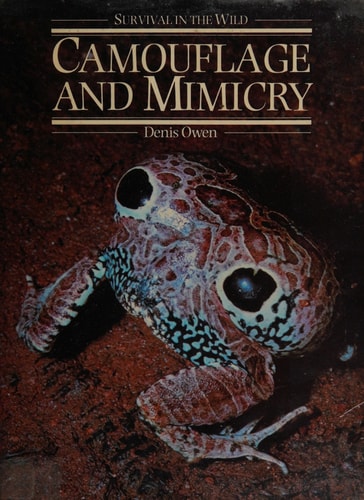
Survival in the Wild: Camouflage and Mimicry
0
0
As an Amazon Associate and affiliate partner, Menrva Books earns from qualifying purchases. Learn more
Author Description
Many organisms, to avoid being noticed, combine color and shape to create elaborate and highly effective disguises. Some have evolved uncanny likenesses to such elements of their environment as leaves and rocks. Others use color and shape in more spectacular displays simply to frighten a predator or to warn that they are poisonous. In turn, and to complicate matters for their enemies, some edible animals have evolved a striking likeness to poisonous animals that use color as a warning. Though such camouflage and mimicry is most widely and brilliantly evident among the insects?where sometimes only the experienced naturalist can see through the deception?it has also evolved in plants and several groups of vertebrates, including birds, snakes, and salamanders.Camouflage and Mimicry describes the remarkably varied attempts of species to deceive their predators and prey. It illustrates a group of strategies which help to increase an individual's chances of survival.
Menrva's Summary
THE THESIS
This text investigates the evolutionary mechanisms and biological strategies organisms employ to deceive predators and prey through camouflage and mimicry. The authors, Denis F. Owen, Jennifer C. Owen, and Tim Halliday, utilize their expertise in natural history to examine how color, shape, and behavioral displays function as survival adaptations. The book argues that these deceptive traits are not merely aesthetic but are critical evolutionary responses to environmental pressures and predation risks.
THE SCOPE MAP
What You Will Find
- Analysis of camouflage techniques including crypsis and disruptive coloration
- Examination of mimicry types such as Batesian and Müllerian mimicry
- Comparative studies across insects, birds, snakes, and salamanders
- Discussion of plant-based defensive disguises
Scope Limits
- The text does not provide an exhaustive catalog of every known species utilizing these traits
- It does not focus on the molecular genetic pathways of color production
THE AUTHORITY PERSPECTIVE
Experts recognize this work as a clear and accessible introduction to the biological principles of defensive deception. Readers frequently note that the text balances scientific observation with descriptive clarity, making it a useful resource for students and naturalists alike.
Page Count:
158
Publication Date:
1980-10-30
Publisher:
Oxford University Press
ISBN-10:
0192176838
ISBN-13:
9780192176837
Science
Nature
Biology
Zoology
Evolutionary Biology
Ecology
Community Tags
Similar Books