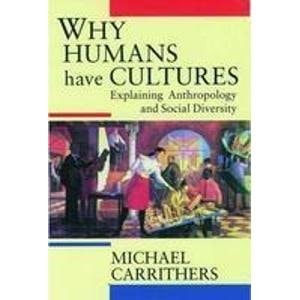
Why Humans Have Cultures: Explaining Anthropology and Social Diversity
0
0
As an Amazon Associate and affiliate partner, Menrva Books earns from qualifying purchases. Learn more
Author Description
How and why do humans create so many different forms of life? This book presents an original and powerful answer to this central problem of anthropology.Why Humans Have Cultures asks three basic questions: what unity underlies cultural diversity? What are the origins of that diversity? How can we understand it? Michael Carrithers argues that it is the ways in which people interact with each other, rather than technological advances, that have been of crucial importance in human history. The human capacity for social interaction, whether on a grand scale or between individuals, is a prime mover in the continual process of social innovation. The imaginative and flexible nature of human social intelligence has created the vast and complex web of different cultures, societies, and histories which exist today.In this lucid and thought-provoking book, Michael Carrithers draws both on ancient and contemporary examples to show how this perspective forms a firm foundation for the study of culture, society, and history. It is necessary, he argues, to look at societies rather than technologies in order to produce challenging, useful, and reliable knowledge about ourselves.
Menrva's Summary
THE THESIS
This book investigates the fundamental question of how and why humans generate such a vast array of distinct cultural forms and social structures. Michael Carrithers, an established scholar in the field, challenges the traditional focus on technological determinism by proposing that social interaction is the primary driver of human innovation. He argues that the inherent flexibility and imaginative capacity of human social intelligence serve as the foundation for the complex web of societies observed throughout history.
THE SCOPE MAP
What You Will Find
- A theoretical framework prioritizing social interaction over technological advancement.
- Analysis of the origins and unity underlying global cultural diversity.
- Comparative studies utilizing both ancient and contemporary historical examples.
Scope Limits
- The text does not provide an exhaustive ethnographic survey of every global culture.
- It does not focus on biological or genetic explanations for social behavior.
THE AUTHORITY PERSPECTIVE
Scholars and students of anthropology frequently cite this work for its clear, accessible prose and its departure from materialist interpretations of history. It is widely regarded as a foundational text for those seeking to understand the mechanisms of social innovation and the development of human cultural diversity.
Page Count:
232
Publication Date:
1992-12-24
Publisher:
Oxford University Press
ISBN-10:
0192192272
ISBN-13:
9780192192271
Human History
Social Science
Anthropology
Sociology
Community Tags
Similar Books