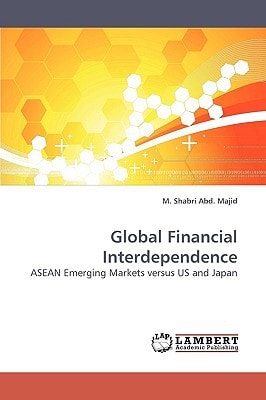
Global Financial Interdependence
0
0
As an Amazon Associate and affiliate partner, Menrva Books earns from qualifying purchases. Learn more
Author Description
This study empirically explores interdependence of ASEAN emerging markets from the US and Japan during the period from July 1, 1987 to June 30, 2002. Using cointegration technique and generalized method of moments (GMM) estimation, the study documents that ASEAN markets are moving towards a greater integration either among themselves or with the US and Japan. This implies that the benefits from diversifying investments across ASEAN markets will gradually diminish. In regulating their stock markets, the ASEAN countries should take into consideration any developments in their neighbouring countries as well as in the US and Japan.
Menrva's Summary
THE THESIS
This study empirically explores the interdependence of ASEAN emerging markets with the US and Japan during a specific historical period. The author, M. Shabri Abd. Majid, utilizes cointegration techniques and generalized method of moments (GMM) estimation to analyze financial market data. The core argument presented is that ASEAN markets are increasingly integrated, both internally and with major global economies, suggesting a reduction in diversification benefits and a need for coordinated regulatory considerations.
THE SCOPE MAP
- Analysis of financial interdependence among ASEAN emerging markets.
- Examination of the relationship between ASEAN markets and the US and Japan.
- Application of cointegration technique and GMM estimation.
- Empirical data covering the period from July 1, 1987, to June 30, 2002.
- Documentation of increasing integration within ASEAN and with global powers.
- Implications for investment diversification strategies.
- Recommendations for ASEAN countries regarding regulatory considerations.
THE AUTHORITY PERSPECTIVE
This work provides an empirical investigation into the financial interconnectedness of ASEAN emerging markets with the US and Japan, employing rigorous econometric methods. The study's findings suggest a trend towards greater market integration, which has significant implications for investment strategies and regulatory policy within the region. The analysis is grounded in a specific historical dataset, offering a focused perspective on the dynamics of global financial interdependence during the late 20th and early 21st centuries.
Page Count:
292
Publication Date:
2009-09-01
Publisher:
Lap Lambert Academic Publishing GmbH KG
ISBN-10:
3838306473
ISBN-13:
9783838306476
Non-Fiction
Economics
Finance
Community Tags
Similar Books