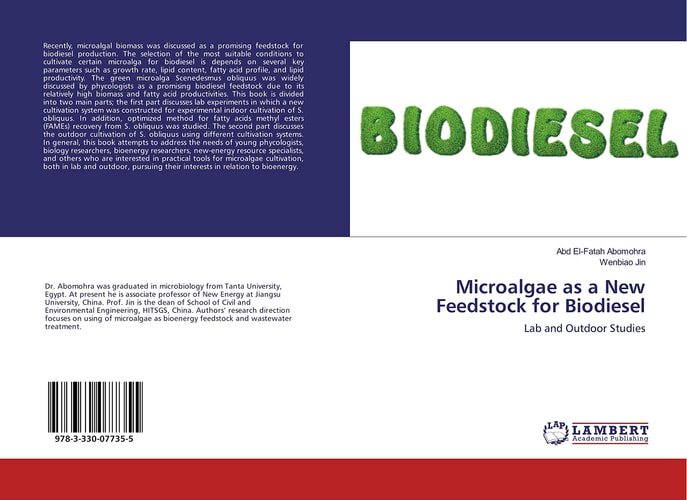
Microalgae as a New Feedstock for Biodiesel: Lab and Outdoor Studies
0
0
As an Amazon Associate and affiliate partner, Menrva Books earns from qualifying purchases. Learn more
Author Description
Recently, microalgal biomass was discussed as a promising feedstock for biodiesel production. The selection of the most suitable conditions to cultivate certain microalga for biodiesel is depends on several key parameters such as growth rate, lipid content, fatty acid profile, and lipid productivity. The green microalga Scenedesmus obliquus was widely discussed by phycologists as a promising biodiesel feedstock due to its relatively high biomass and fatty acid productivities. This book is divided into two main parts; the first part discusses lab experiments in which a new cultivation system was constructed for experimental indoor cultivation of S. obliquus. In addition, optimized method for fatty acids methyl esters (FAMEs) recovery from S. obliquus was studied. The second part discusses the outdoor cultivation of S. obliquus using different cultivation systems. In general, this book attempts to address the needs of young phycologists, biology researchers, bioenergy researchers, new-energy resource specialists, and others who are interested in practical tools for microalgae cultivation, both in lab and outdoor, pursuing their interests in relation to bioenergy.
Menrva's Summary
THE THESIS
This book investigates the optimization of microalgal biomass cultivation for biodiesel production, focusing on the green microalga Scenedesmus obliquus. The authors detail laboratory experiments involving a novel cultivation system and an optimized method for fatty acid methyl ester (FAMEs) recovery. The second part explores outdoor cultivation techniques using various systems, aiming to provide practical tools for researchers in bioenergy and phycology.
THE SCOPE MAP
- Lab experiments with a new cultivation system for indoor growth of Scenedesmus obliquus.
- Optimized method for fatty acid methyl ester (FAMEs) recovery from microalgal biomass.
- Outdoor cultivation of Scenedesmus obliquus using different cultivation systems.
- Practical tools and insights for microalgae cultivation in both laboratory and outdoor settings.
- Focus on key parameters for biodiesel feedstock selection: growth rate, lipid content, fatty acid profile, and lipid productivity.
THE AUTHORITY PERSPECTIVE
The book is presented as a practical guide for young phycologists, bioenergy researchers, and specialists in new energy resources. Its detailed approach to both laboratory and outdoor cultivation suggests it is aimed at individuals seeking hands-on knowledge in microalgae cultivation for bioenergy applications. The structured division into lab and outdoor studies indicates a comprehensive exploration of the subject matter. The emphasis on Scenedesmus obliquus as a promising feedstock highlights a specific focus within the broader field of renewable energy research.
Page Count:
96
Publication Date:
2017-04-20
Publisher:
LAP LAMBERT Academic Publishing
ISBN-10:
3330077352
ISBN-13:
9783330077355
Science & Technology
Non-Fiction
Science
Community Tags
Similar Books