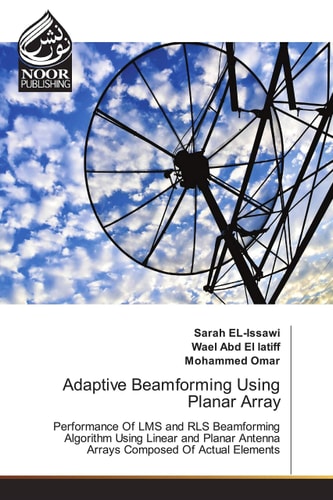
Adaptive Beamforming Using Planar Array Performance Of LMS and RLS Beamforming Algorithm Using Linear and Planar Antenna Arrays Composed Of Actual Elements
0
0
As an Amazon Associate and affiliate partner, Menrva Books earns from qualifying purchases. Learn more
Author Description
Beamforming algorithms are considered to be the main process in smart antennas systems. In most applications that are using beamforming algorithms such as Least Mean Square and Recursive Least Square beamforming algorithms, the elements of the antenna array are assumed to be point sources and practically the antennas array elements in the linear and planar array have dimensions so mutual coupling must be considered. To determine whether or not the beamforming algorithms can be applied using half-wavelength dipole antenna elements instead of isotropic point sources, the LMS and RLS beamforming algorithms are applied in this thesis. Both algorithms are applied using real elements, thin wire antenna dipole antennas or rectangular patch antennas. The mutual coupling effects and simulation results are obtained by using two computer programs tools MATLAB and SUPERNEC, simulation results show the plots of array factor patterns, resulting adapted weights magnitude, mean square error (MSE), desired and output array signals to emphasize the performances differences in both algorithms before and after mutual coupling consideration in Linear and planar array.
Menrva's Summary
THE THESIS
This thesis investigates the practical application of adaptive beamforming algorithms in smart antenna systems by considering the physical dimensions of antenna elements rather than idealized point sources. The authors, Mohammed Omar, Sarah EL-Issawi, and Wael Abd El latiff, examine the performance of the Least Mean Square (LMS) and Recursive Least Square (RLS) beamforming algorithms when applied to linear and planar antenna arrays composed of actual half-wavelength dipole antenna elements or rectangular patch antennas. The study addresses the critical aspect of mutual coupling effects, which are often ignored in theoretical models, and quantifies their impact on the algorithms' performance. Simulation results, generated using MATLAB and SUPERNEC, are presented to highlight these differences.
THE SCOPE MAP
- Analysis of LMS and RLS beamforming algorithms in smart antenna systems.
- Consideration of real antenna elements (half-wavelength dipoles, rectangular patches) versus isotropic point sources.
- Investigation of mutual coupling effects in linear and planar antenna arrays.
- Simulation results using MATLAB and SUPERNEC.
- Presentation of array factor patterns.
- Analysis of adapted weights magnitude.
- Evaluation of Mean Square Error (MSE).
- Comparison of desired and output array signals to emphasize performance differences.
THE AUTHORITY PERSPECTIVE
This work presents a detailed technical analysis of adaptive beamforming algorithms, specifically focusing on the practical implications of using real antenna elements with mutual coupling effects. The authors employ established simulation tools and present quantitative results to differentiate the performance of LMS and RLS algorithms under these realistic conditions. The research appears to be aimed at engineers and researchers in the field of antenna design and signal processing who require a deeper understanding of how physical antenna characteristics influence beamforming performance.
Page Count:
140
Publication Date:
2017-01-10
Publisher:
Noor Publishing
ISBN-10:
333084485X
ISBN-13:
9783330844858
Science
Science & Technology
Engineering
Community Tags
Similar Books