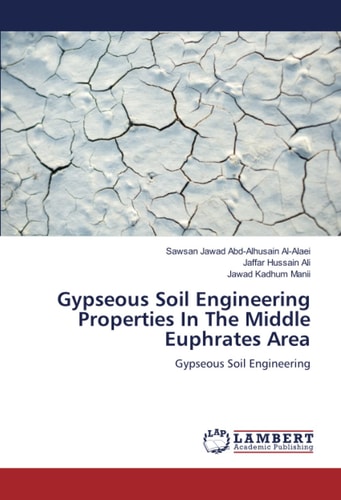
Gypseous Soil Engineering Properties In The Middle Euphrates Area: Gypseous Soil Engineering
0
0
As an Amazon Associate and affiliate partner, Menrva Books earns from qualifying purchases. Learn more
Author Description
This book deals with the geotechnical evaluation of Gypsiferous soil in four governorates in the middle Euphrates of Iraq (Babylon, Kerbala, Al‐ Najaf and Al‐ Qadissiya) The results of the grain size analyses revealed that the soil in the study area are alluvial origin and it is non-homogeneous and it contains large ranges of the size of grains. The grain size distribution of the gypsiferous soils of study area shows the sands percentage to be higher than those of the silt, clay and gravel percentages; the gravel percentage ranges between (0%‐46%), the sand percentage ranges between 8% ‐ 95%; the silt percentage range between 3% ‐ 68%; the clay percentage range between 0%‐ 76 %. The wet density values range between 1.772 gm/cm3 ‐ 2.538 gm/cm3, while the dry density values range between 1.549 gm/cm3 – 2.474 gm/cm3 the soil of the study area is low density because it contains a quantity of gypsum which has a low density. The engineering properties of the soil revealed that the direct shear values for soil cohesion(c), range between 0.0 KN/m2 ‐ 150 KN/m2. The internal friction angle (Ø°)of the soil study area ranges from 18°‐50°.
Menrva's Summary
THE THESIS
This book investigates the geotechnical properties of gypsiferous soil in a specific region of Iraq. The study focuses on four governorates in the middle Euphrates area: Babylon, Kerbala, Al-Najaf, and Al-Qadissiya. It presents detailed findings on grain size distribution, revealing alluvial origins and significant variations in grain sizes, with sand percentages often being the highest. The research also quantifies wet and dry density values, attributing lower densities to the presence of gypsum, and provides ranges for direct shear values concerning soil cohesion and internal friction angles.
THE SCOPE MAP
- Geotechnical evaluation of gypsiferous soil in Babylon, Kerbala, Al-Najaf, and Al-Qadissiya governorates.
- Analysis of grain size distribution, indicating alluvial origin and non-homogeneous soil composition.
- Detailed percentages for gravel, sand, silt, and clay content.
- Ranges for wet density (gm/cm³) and dry density (gm/cm³).
- Findings on the impact of gypsum on soil density.
- Direct shear test results for soil cohesion (c) in KN/m².
- Ranges for the internal friction angle (Ø°) of the soil.
THE AUTHORITY PERSPECTIVE
This technical report presents empirical data on the engineering properties of gypsiferous soils in a specific geographical area. The detailed analysis of soil composition, density, and shear strength parameters offers valuable information for civil and geotechnical engineers working in similar environments. The findings are grounded in laboratory analyses and provide quantitative data crucial for infrastructure development and soil stabilization strategies in the Middle Euphrates region.
Page Count:
144
Publication Date:
2022-07-25
Publisher:
LAP LAMBERT Academic Publishing
ISBN-10:
620471774X
ISBN-13:
9786204717746
Science
Non-Fiction
Iraq
Middle East
Civil Engineering
Soil Science
Geotechnical Engineering
Community Tags
Similar Books