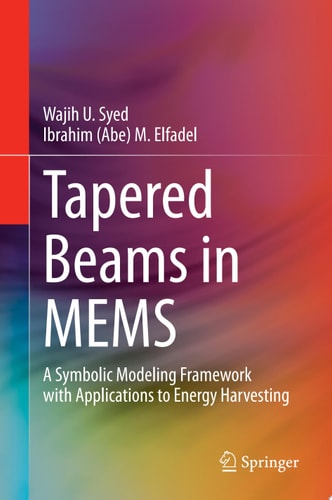
Tapered Beams in MEMS
0
0
As an Amazon Associate and affiliate partner, Menrva Books earns from qualifying purchases. Learn more
Author Description
This book addresses important aspects of MEMS designs that are well established in engineering practice but rarely discussed in the standard textbooks. One such aspect is the ubiquitous use of tapered beams in the sensing and actuation elements of MEMS designs. As explained in this book, the tapered beam has distinct advantages over the standard rectangular beam but these advantages are often left unarticulated due to the blind trust in the finite-element models of MEMS devices. In this monograph, the authors take a fundamental, physics-based approach to the modeling of tapered beams in MEMS that is based on a rigorous perturbation analysis of the traditional Euler-Bernoulli beam. The authors demonstrate how perturbation methods combined with symbolic modeling and the tools of computer algebra enable the development of semi-analytical models for tapered-beam MEMS elements. They pay particular attention to the application of these novel models to piezoelectric MEMS energy harvesters with tapered-beam elements, including the development of lumped-parameter circuit models that can be readily used for fast electro-mechanical simulations. Another important aspect of MEMS designs that is extensively addressed in the book is the uncertainty quantification (UQ) of tapered-beam MEMS elements using both Monte Carlo and polynomial chaos expansion methods. These UQ methods are applied to the design of variation-aware piezoelectric energy harvesters. With consistent focus on MEMS devices with tapered beam elements, this up-to-date monograph
Menrva's Summary
THE THESIS
This monograph investigates the under-discussed but critical role of tapered beams in Micro-Electro-Mechanical Systems (MEMS) design. The authors present a physics-based approach to modeling these ubiquitous elements, moving beyond the reliance on finite-element models. Through rigorous perturbation analysis of Euler-Bernoulli beams, they develop semi-analytical models using symbolic computation, with a particular focus on piezoelectric MEMS energy harvesters. The book also addresses uncertainty quantification for tapered-beam MEMS elements, applying Monte Carlo and polynomial chaos expansion methods to variation-aware designs.
THE SCOPE MAP
- Fundamental, physics-based approach to modeling tapered beams in MEMS.
- Rigorous perturbation analysis of the traditional Euler-Bernoulli beam.
- Development of semi-analytical models using symbolic modeling and computer algebra tools.
- Application to piezoelectric MEMS energy harvesters with tapered-beam elements.
- Creation of lumped-parameter circuit models for fast electro-mechanical simulations.
- Uncertainty quantification (UQ) of tapered-beam MEMS elements.
- Application of Monte Carlo and polynomial chaos expansion methods for UQ.
- Design of variation-aware piezoelectric energy harvesters.
THE AUTHORITY PERSPECTIVE
This monograph offers a deep dive into the specialized topic of tapered beams in MEMS, a design aspect often overlooked in standard engineering textbooks. The authors' rigorous, physics-based approach and application of advanced mathematical tools like perturbation analysis and symbolic computation are central to their contribution. The focus on practical applications, such as piezoelectric energy harvesters and uncertainty quantification, suggests the book is aimed at researchers and practicing engineers in the field. The detailed methodology and specific applications indicate a text that provides significant technical depth for its intended audience.
Page Count:
236
Publication Date:
2024-10-18
Publisher:
Springer Nature
ISBN-10:
3031663918
ISBN-13:
9783031663918
Non-Fiction
Science & Technology
Community Tags
Similar Books