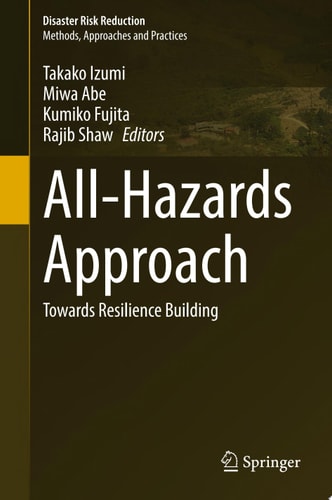
All-Hazards Approach
0
0
As an Amazon Associate and affiliate partner, Menrva Books earns from qualifying purchases. Learn more
Author Description
This book presents case studies of risk management of various hazards and risk management systems at regional, national, and local levels. It also proposes a comprehensive approach to reduce future risks by collaborating with various stakeholders and preparing for the most effective responses toward complicated hazards, minimizing social damage. The COVID-19 pandemic has increased the concern as well as interest in the diversification of future risks and the complexity of the damage and impact that multiple risks may cause. These hazard risks include not only natural hazards, but also biological, industrial, and nuclear hazards along with other risks such as cyber-attacks, climate change, food security, conflict, and multiple hazards occurring simultaneously.The Sendai Framework for Disaster Risk Reduction, adopted in 2015 at the United Nations World Conference on Disaster Risk Reduction, accounts for the risks caused by natural or manmade hazards as well as related environmental, technological, and biological hazards and risks. The framework guides the multi-hazard management of disaster risk in development at all levels and sectors. However, in the current disaster management system in most countries, different offices are responsible for each different hazard, making it extremely difficult to manage those hazard risks comprehensively. Having experienced the COVID-19 pandemic, it is now time to review the current risk management strategy and system, and thereafter discuss how to strengthen and transform our risk perception and manner of risk assessment and identification to tackle future multiple hazards. Simultaneously, further collaboration among experts from different backgrounds and fields will become indispensable. While the discussion of the need for an “all-hazards approach” has taken place for many years, there now needs to be discussion of a risk-focused framework.
Menrva's Summary
THE THESIS
This book investigates the challenges and proposes solutions for a comprehensive, 'all-hazards approach' to risk management in an increasingly complex world. The authors, drawing on case studies from regional to local levels, address the fragmentation of current disaster management systems where different offices handle distinct hazards. They argue for a unified, risk-focused framework that integrates various stakeholders and prepares for multifaceted threats, including natural, biological, industrial, nuclear, cyber, climate change, and food security risks, especially in light of recent global events like the COVID-19 pandemic.
THE SCOPE MAP
- Case studies of risk management for diverse hazards (natural, biological, industrial, nuclear, cyber, climate change, food security).
- Analysis of risk management systems at regional, national, and local levels.
- Proposal for a comprehensive 'all-hazards approach' to risk reduction.
- Emphasis on collaboration among various stakeholders and experts.
- Discussion on preparing for effective responses to complicated and multiple hazards.
- Exploration of how to strengthen risk perception, assessment, and identification.
- Alignment with the principles of the Sendai Framework for Disaster Risk Reduction.
THE AUTHORITY PERSPECTIVE
The book addresses the critical need for an integrated approach to disaster risk management, a topic gaining urgency with the increasing complexity of global threats. It aims to bridge the gap between the theoretical concept of an 'all-hazards approach' and its practical implementation, highlighting the limitations of current fragmented systems. The authors advocate for a paradigm shift in how societies perceive, assess, and respond to a wide spectrum of risks, emphasizing interdisciplinary collaboration. This work is positioned to inform policymakers, disaster management professionals, and researchers seeking to enhance resilience against future, multifaceted crises.
Page Count:
284
Publication Date:
2024-10-12
Publisher:
Springer Nature
ISBN-10:
9819718600
ISBN-13:
9789819718603
Non-Fiction
Science & Technology
Community Tags
Similar Books















Reader Comments
Share Your Thoughts
No comments yet. Be the first to share your thoughts!