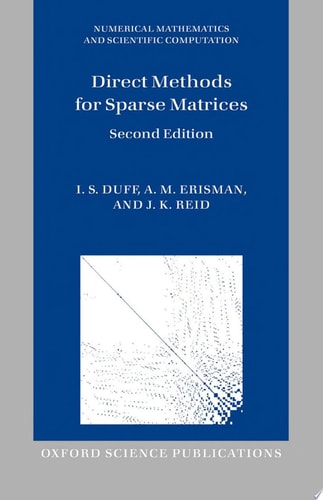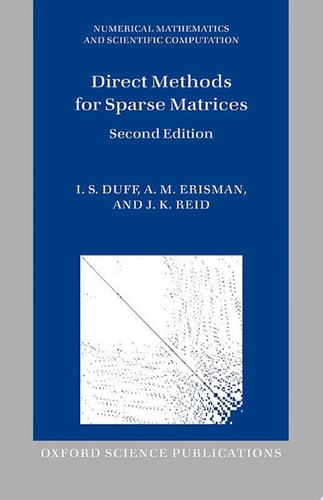
Direct Methods for Sparse Matrices
0
0
As an Amazon Associate and affiliate partner, Menrva Books earns from qualifying purchases. Learn more
Author Description
The subject of sparse matrices has its root in such diverse fields as management science, power systems analysis, surveying, circuit theory, and structural analysis. Efficient use of sparsity is a key to solving large problems in many fields. This second edition is a complete rewrite of the first edition published 30 years ago. Much has changed since that time. Problems have grown greatly in size and complexity; nearly all examples in the first edition were of order less than 5,000 in the first edition, and are often more than a million in the second edition. Computer architectures are now much more complex, requiring new ways of adapting algorithms to parallel environments with memory hierarchies. Because the area is such an important one to all of computational science and engineering, a huge amount of research has been done in the last 30 years, some of it by the authors themselves. This new research is integrated into the text with a clear explanation of the underlying mathematics and algorithms. New research that is described includes new techniques for scaling and error control, new orderings, new combinatorial techniques for partitioning both symmetric and unsymmetric problems, and a detailed description of the multifrontal approach to solving systems that was pioneered by the research of the authors and colleagues. This includes a discussion of techniques for exploiting parallel architectures and new work for indefinite and unsymmetric systems.
Menrva's Summary
THE THESIS
This text investigates the mathematical and algorithmic advancements required to solve large-scale sparse matrix problems in modern computational science. The authors, A. M. Erisman, I. S. Duff, and J. K. Reid, leverage their extensive research experience to update foundational methods for contemporary hardware. They present a rigorous framework for handling systems that have grown from thousands to millions of variables, emphasizing the necessity of adapting algorithms to parallel environments and complex memory hierarchies.
THE SCOPE MAP
What You Will Find
- Techniques for scaling and error control in sparse systems
- Combinatorial methods for partitioning symmetric and unsymmetric problems
- Detailed analysis of the multifrontal approach to solving linear systems
- Strategies for exploiting parallel computer architectures
Scope Limits
- The text focuses primarily on direct methods rather than iterative solvers
- It assumes a high level of mathematical maturity and familiarity with linear algebra
THE AUTHORITY PERSPECTIVE
Experts recognize this volume as a definitive reference for the evolution of sparse matrix computation over the last three decades. Readers frequently note the technical density of the prose, which serves as a foundational resource for researchers and practitioners in computational engineering.
Page Count:
449
Publication Date:
2017-01-01
Publisher:
OUP Oxford
ISBN-10:
0192507516
ISBN-13:
9780192507518
Computer Science
Matrices
Numerical analysis
Scientific Computing
Functional analysis
Post-Calculus
Mathematics
Algorithms
Mathematics Statistics