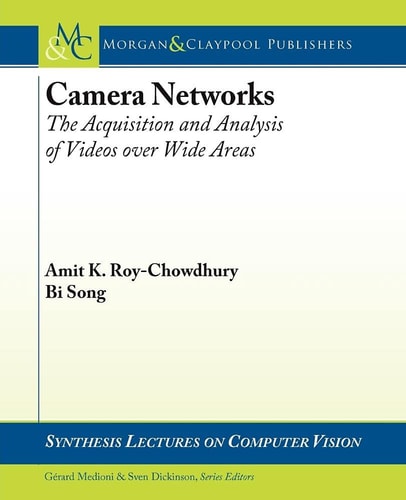
Camera Networks: The Acquisition and Analysis of Videos Over Wide Areas
0
0
As an Amazon Associate and affiliate partner, Menrva Books earns from qualifying purchases. Learn more
Author Description
As networks of video cameras are installed in many applications like security and surveillance, environmental monitoring, disaster response, and assisted living facilities, among others, image understanding in camera networks is becoming an important area of research and technology development. There are many challenges that need to be addressed in the process. Some of them are listed below: - Traditional computer vision challenges in tracking and recognition, robustness to pose, illumination, occlusion, clutter, recognition of objects, and activities; - Aggregating local information for wide area scene understanding, like obtaining stable, long-term tracks of objects; - Positioning of the cameras and dynamic control of pan-tilt-zoom (PTZ) cameras for optimal sensing; - Distributed processing and scene analysis algorithms; - Resource constraints imposed by different applications like security and surveillance, environmental monitoring, disaster response, assisted living facilities, etc. In this book, we focus on the basic research problems in camera networks, review the current state-of-the-art and present a detailed description of some of the recently developed methodologies. The major underlying theme in all the work presented is to take a network-centric view whereby the overall decisions are made at the network level. This is sometimes achieved by accumulating all the data at a central server, while at other times by exchanging decisions made by individual cameras based on their locally sensed data. Chapter One starts with an overview of the problems in camera networks and the major research directions. Some of the currently available experimental testbeds are also discussed here. One of the fundamental tasks in the analysis of dynamic scenes is to track objects. Since camera networks cover a large area, the systems need to be able to track over such wide areas where there could be both overlapping and non-overlapping fields of view of the cameras, as addressed
Menrva's Summary
THE THESIS
This book investigates the challenges and methodologies for understanding visual information across distributed networks of cameras. The authors, Amit K. Roy-Chowdhury and Bi Song, address critical issues in image understanding for applications such as security, environmental monitoring, and disaster response. They explore traditional computer vision problems like tracking and recognition under varying conditions, as well as the complexities of aggregating local information for wide-area scene comprehension and optimizing camera positioning and control. The book emphasizes a network-centric approach, where decisions are made at the network level, either by centralizing data or by exchanging local decisions.
THE SCOPE MAP
- Overview of problems and research directions in camera networks.
- Discussion of experimental testbeds for camera network research.
- Methodologies for object tracking across wide areas with overlapping and non-overlapping camera views.
- Techniques for aggregating local information for stable, long-term object tracks.
- Strategies for camera positioning and dynamic control of PTZ cameras.
- Algorithms for distributed processing and scene analysis.
- Consideration of resource constraints in various application domains.
- Focus on network-level decision-making for overall scene understanding.
THE AUTHORITY PERSPECTIVE
This book addresses the fundamental research problems in camera networks, reviewing the current state-of-the-art and detailing recently developed methodologies. The authors highlight the importance of a network-centric view for making overall decisions, achieved through data aggregation or distributed decision exchange. The content is structured to provide a comprehensive understanding of the field, starting with an overview of challenges and research directions. It delves into specific tasks like object tracking across large, potentially complex visual fields.
Page Count:
119
Publication Date:
2012-01-01
Publisher:
Morgan & Claypool Publishers
ISBN-10:
1608456749
ISBN-13:
9781608456741
Science
Non-Fiction
Computer Vision
Image Processing
Community Tags
Similar Books













Reader Comments
Share Your Thoughts
No comments yet. Be the first to share your thoughts!