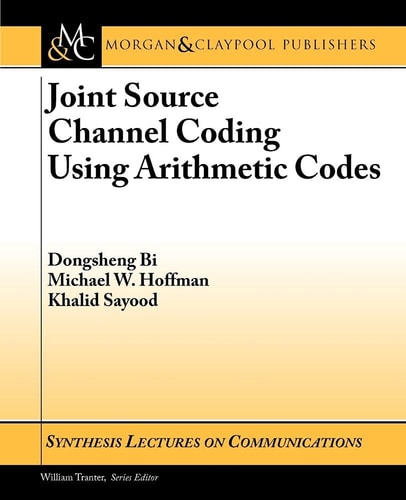
Joint Source Channel Coding Using Arithmetic Codes
0
0
As an Amazon Associate and affiliate partner, Menrva Books earns from qualifying purchases. Learn more
Author Description
Based on the encoding process, arithmetic codes can be viewed as tree codes and current proposals for decoding arithmetic codes with forbidden symbols belong to sequential decoding algorithms and their variants. In this monograph, we propose a new way of looking at arithmetic codes with forbidden symbols. If a limit is imposed on the maximum value of a key parameter in the encoder, this modified arithmetic encoder can also be modeled as a finite state machine and the code generated can be treated as a variable-length trellis code. The number of states used can be reduced and techniques used for decoding convolutional codes, such as the list Viterbi decoding algorithm, can be applied directly on the trellis. The finite state machine interpretation can be easily migrated to Markov source case. We can encode Markov sources without considering the conditional probabilities, while using the list Viterbi decoding algorithm which utilizes the conditional probabilities. We can also use context-based arithmetic coding to exploit the conditional probabilities of the Markov source and apply a finite state machine interpretation to this problem. The finite state machine interpretation also allows us to more systematically understand arithmetic codes with forbidden symbols. It allows us to find the partial distance spectrum of arithmetic codes with forbidden symbols. We also propose arithmetic codes with memories which use high memory but low implementation precision arithmetic codes. The low implementation precision results in a state machine with less complexity. The introduced input memories allow us to switch the probability functions used for arithmetic coding. Combining these two methods give us a huge parameter space of the arithmetic codes with forbidden symbols. Hence we can choose codes with better distance properties while maintaining the encoding efficiency and decoding complexity. A construction and search method is proposed and simulation results show that we can a
Menrva's Summary
THE THESIS
This monograph proposes a novel framework for understanding and decoding arithmetic codes with forbidden symbols by reinterpreting them as finite state machines and variable-length trellis codes. The authors introduce a modification to the arithmetic encoder that allows it to be modeled as a finite state machine, enabling the application of techniques used for decoding convolutional codes, such as the list Viterbi decoding algorithm. This interpretation is extended to Markov sources, allowing for efficient encoding without explicit conditional probability consideration during encoding, while still utilizing these probabilities during decoding. The work also explores arithmetic codes with memories, which balance high memory usage with low implementation precision, offering a vast parameter space for optimizing distance properties and maintaining encoding efficiency and decoding complexity.
THE SCOPE MAP
- Modeling arithmetic codes with forbidden symbols as finite state machines.
- Application of list Viterbi decoding algorithm to trellis codes generated by modified arithmetic encoders.
- Encoding Markov sources without explicit conditional probability consideration during encoding.
- Utilizing context-based arithmetic coding and finite state machine interpretation for Markov sources.
- Analysis of partial distance spectrum for arithmetic codes with forbidden symbols.
- Introduction of arithmetic codes with memories for improved performance and reduced complexity.
- Proposed construction and search methods for optimized arithmetic codes.
- Simulation results demonstrating improved encoding efficiency and decoding complexity.
THE AUTHORITY PERSPECTIVE
This work presents a significant theoretical advancement in the field of source channel coding, offering a new perspective on arithmetic codes with forbidden symbols. The proposed finite state machine interpretation and the application of list Viterbi decoding are expected to be of interest to researchers and practitioners in information theory and coding. The exploration of arithmetic codes with memories further expands the potential for developing more efficient and less complex coding schemes. The authors provide simulation results to support their claims, suggesting practical implications for the design of communication systems.
Page Count:
69
Publication Date:
2010-01-01
Publisher:
Morgan & Claypool Publishers
ISBN-10:
1608451488
ISBN-13:
9781608451487
Science & Technology
Non-Fiction
Computer Science
Coding Theory
Information Theory
Community Tags
Similar Books
Reader Comments
Share Your Thoughts
No comments yet. Be the first to share your thoughts!