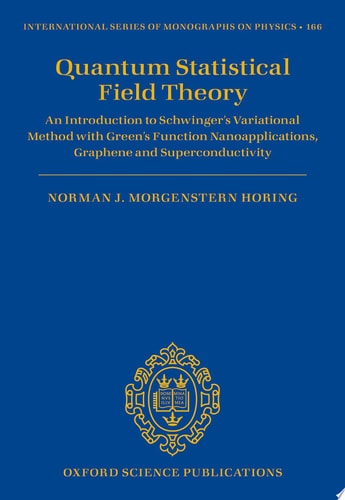
Quantum Statistical Field Theory: An Introduction to Schwinger's Variational Method with Green's Function Nanoapplications, Graphene and Superconductivity
0
0
As an Amazon Associate and affiliate partner, Menrva Books earns from qualifying purchases. Learn more
Author Description
This book provides an introduction to the methods of coupled quantum statistical field theory and Green's functions. The methods of coupled quantum field theory have played a major role in the extensive development of nonrelativistic quantum many-particle theory and condensed matter physics. This introduction to the subject is intended to facilitate delivery of the material in an easily digestible form to advanced undergraduate physics majors at a relatively early stage of their scientific development. The main mechanism to accomplish this is the early introduction of variational calculus and the Schwinger Action Principle, accompanied by Green's functions. Important achievements of the theory in condensed matter and quantum statistical physics are reviewed in detail to help develop research capability. These include the derivation of coupled field Green's function equations-of-motion for a model electron-hole-phonon system, extensive discussions of retarded, thermodynamic and nonequilibrium Green's functions and their associated spectral representations and approximation procedures. Phenomenology emerging in these discussions include quantum plasma dynamic-nonlocal-screening, plasmons, polaritons, linear electromagnetic response, excitons, polarons, phonons, magnetic Landau quantization, van der Waals interactions, chemisorption, etc. Considerable attention is also given to low dimensional and nanostructured systems, including quantum wells, wires, dots and superlattices, as well as materials having exceptional conduction properties such as Superconductors, Superfluids and Graphene.
Menrva's Summary
THE THESIS
This text investigates the application of Schwinger's variational method and Green's function techniques to solve complex problems in quantum statistical field theory. Norman J. Morgenstern Horing, a physicist with extensive experience in many-particle theory, presents a pedagogical framework designed to introduce these advanced mathematical tools to students. By focusing on the Schwinger Action Principle, the author provides a systematic approach to deriving equations of motion for electron-hole-phonon systems, bridging the gap between theoretical formalism and practical condensed matter applications.
THE SCOPE MAP
What You Will Find
- Derivation of coupled field Green's function equations-of-motion.
- Analysis of retarded, thermodynamic, and nonequilibrium Green's functions.
- Application of variational calculus to quantum plasma dynamics and screening.
- Examination of nanostructured systems including quantum wells, wires, and dots.
- Review of phenomena such as plasmons, polaritons, excitons, and superconductivity.
Scope Limits
- The text focuses primarily on nonrelativistic quantum many-particle theory.
- It does not provide an exhaustive treatment of high-energy particle physics or quantum gravity.
THE AUTHORITY PERSPECTIVE
Experts recognize this work as a specialized resource for students and researchers transitioning into advanced condensed matter physics. Readers frequently note the high mathematical density of the prose, which requires a strong background in undergraduate physics to navigate effectively.
Page Count:
448
Publication Date:
2017-01-01
Publisher:
OUP Oxford
ISBN-10:
0192509756
ISBN-13:
9780192509758
Earth Sciences
Nanotechnology
Statistical mechanics
Physics
Academic Textbooks
Condensed Matter Physics
Community Tags
Similar Books