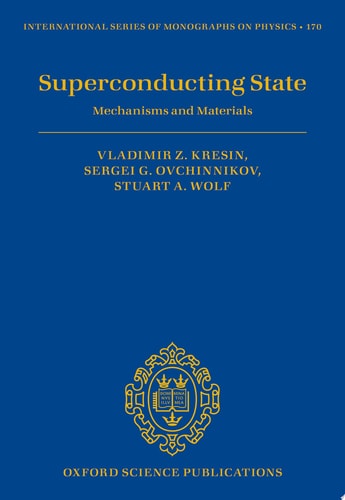
Superconducting State: Mechanisms and Materials
0
0
As an Amazon Associate and affiliate partner, Menrva Books earns from qualifying purchases. Learn more
Author Description
This book provides the reader with a detailed theoretical treatment of the key mechanisms of superconductivity, up to the current state of the art (phonons, magnons, plasmons). In addition, the book describes the properties of key superconducting compounds that are of most interest for science and its applications today. For many years there has been a search for new materials with higher values of the main parameters, such as the critical temperature and the critical current. At present, the possibility to observe superconductivity at room temperature has become perfectly realistic. The book is especially concerned with high Tc systems, such as the high Tc oxides, hydrides with record values of the critical temperature under high pressure, nanoclusters, etc. A number of interesting novel superconducting systems have been discovered recently. Among them: topological materials, interface systems, intercalated graphene. The book contains rigorous derivations, based on statistical mechanics and many-body theory. The book is also providing qualitative explanations of the main concepts and results, which makes it accessible and interesting for a broader readership.
Menrva's Summary
THE THESIS
This text investigates the fundamental mechanisms driving superconductivity and evaluates the physical properties of advanced materials capable of achieving high critical temperatures. The authors, Sergei Ovchinnikov, Stuart A. Wolf, and Vladimir Z. Kresin, utilize their extensive expertise in condensed matter physics to synthesize complex theoretical frameworks, including many-body theory and statistical mechanics. By bridging the gap between abstract mathematical derivations and practical material applications, the authors provide a comprehensive overview of current research into high-temperature superconducting systems.
THE SCOPE MAP
What You Will Find
- Theoretical analysis of phonon, magnon, and plasmon-mediated superconductivity.
- Examination of high-temperature oxides, hydrides under high pressure, and nanoclusters.
- Discussion of emerging systems such as topological materials, interface systems, and intercalated graphene.
- Rigorous mathematical derivations grounded in statistical mechanics.
Scope Limits
- The text does not provide an exhaustive history of early low-temperature superconductivity discoveries.
- It does not focus on commercial manufacturing processes or industrial-scale production techniques.
THE AUTHORITY PERSPECTIVE
Experts recognize this volume as a rigorous resource for researchers and graduate students seeking a deep understanding of modern superconducting mechanisms. Readers frequently note that while the text contains dense mathematical derivations, it remains accessible through its inclusion of qualitative conceptual explanations.
Page Count:
1216
Publication Date:
2021-01-01
Publisher:
OUP Oxford
ISBN-10:
0192584022
ISBN-13:
9780192584021
Condensed Matter Physics
Earth Sciences
Physics