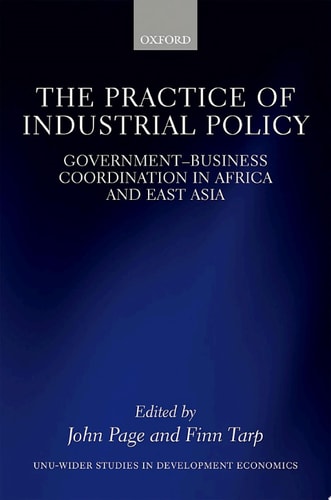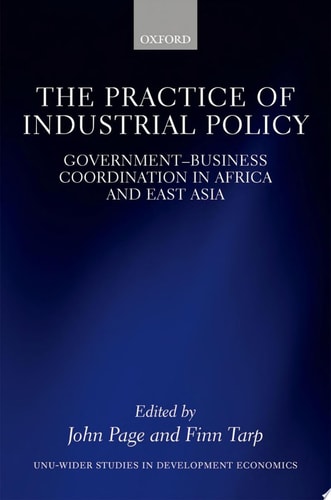
The Practice of Industrial Policy
0
0
As an Amazon Associate and affiliate partner, Menrva Books earns from qualifying purchases. Learn more
Author Description
This is an open access title available under the terms of a CC BY-NC-SA 3.0 IGO licence. It is free to read at Oxford Scholarship Online and offered as a free PDF download from OUP and selected open access locations. Much of the information relevant to policy formulation for industrial development is held by the private sector, not by public officials. There is therefore fairly broad agreement in the development literature that some form of structured engagement — often referred to as close or strategic coordination — between the public and private sectors is needed, both to assist in the design of appropriate policies and to provide feedback on their implementation. There is less agreement on how that engagement should be structured, how its objectives should be defined, and how success should be measured. In fact, the academic literature on close coordination provides little practical guidance on how governments interested in developing a framework for government—business engagement should go about doing it. The burden of this lack of guidance falls most heavily on Africa, where — despite 20 years of growth — lack of structural transformation has slowed job creation and the pace of poverty reduction. Increasingly, African governments are seeking to design and implement policies to encourage the more rapid growth of high productivity industries and in the process confronting the need to engage constructively with the private sector. These efforts have met with mixed results. For sustained success in structural transformation, new policies and new approaches to government-business coordination will be needed. In 2014 the Korea International Cooperation Agency and UNU-WIDER launched a joint research project on 'The Practice of Industrial Policy'. The objective of the project was to help African policy-makers develop better coordination between the public and private sectors in order to identify the constraints to faster structural transformation and to design, implem
Menrva's Summary
THE THESIS
This book investigates the practical mechanisms for structured engagement between public officials and the private sector to foster industrial development and structural transformation. The authors, John M. Page Jr. and Finn Tarp, utilize research from a joint project between the Korea International Cooperation Agency and UNU-WIDER to address the gap between theoretical industrial policy and its implementation. The text argues that while coordination is widely recognized as necessary, there is a lack of actionable frameworks for governments, particularly in Africa, to effectively design and measure such partnerships.
THE SCOPE MAP
What You Will Find
- Frameworks for government-business coordination in developing economies.
- Analysis of structural transformation challenges in Africa.
- Methodologies for identifying constraints to high-productivity industry growth.
- Case studies on policy implementation and feedback loops.
Scope Limits
- The text does not provide a universal blueprint for all global economies.
- It does not cover long-term macroeconomic forecasting beyond the scope of industrial policy.
THE AUTHORITY PERSPECTIVE
Experts and development economists view this work as a practical resource for policy-makers seeking to bridge the gap between theory and execution. Readers frequently note the focus on African development contexts as a significant contribution to the literature on industrial strategy.
Page Count:
312
Publication Date:
2017-01-01
Publisher:
Oxford University Press
ISBN-10:
0192517279
ISBN-13:
9780192517272
Economics
Government relations
Industrial Policy
Public Policy
Community Tags
Similar Books