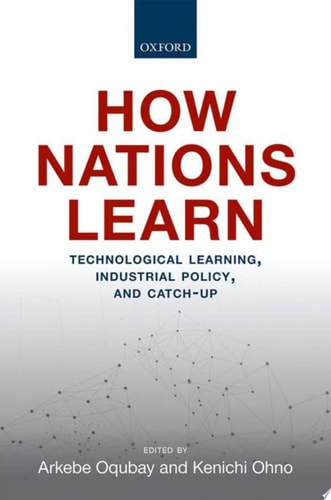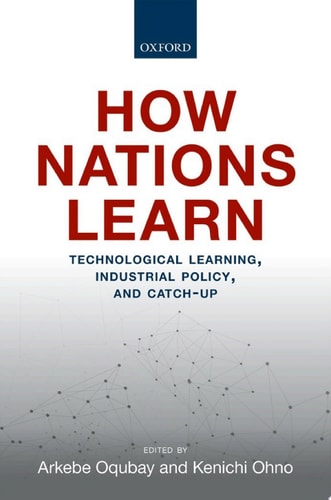
How Nations Learn: Technological Learning, Industrial Policy, and Catch-up
0
0
As an Amazon Associate and affiliate partner, Menrva Books earns from qualifying purchases. Learn more
Author Description
This is an open access title available under the terms of a CC BY-NC-ND 4.0 International licence. It is free to read at Oxford Scholarship Online and offered as a free PDF download from OUP and selected open access locations. What are the prospects for successful learning and catch-up for nations in the twenty-first century? Why have some nations succeeded while others failed? The World Bank states that out of over one hundred middle-income economies in 1960, only thirteen became high income by 2008. How Nations Learn: Technological Learning, Industrial Policy, and Catch-up examines how nations learn by reviewing key structural and contingent factors that contribute to dynamic learning and catch-up. Rejecting both the 'one-size-fits-all' approach and the agnosticism that all nations are unique and different, it uses historical as well as firm-, industry-, and country-level evidence and experiences to identify the sources and drivers of successful learning and catch-up and the lessons for late-latecomer countries. Authored by eminent scholars, the volume aims to generate interest and debate among policy makers, practitioners, and researchers on the complexity of learning and catch-up. It explores technological learning at the firm level, policy learning by the state, and the cumulative and multifaceted nature of the learning process, which encompasses learning by doing, by experiment, emulation, innovation, and leapfrogging.
Menrva's Summary
THE THESIS
This book investigates the structural and contingent factors that determine why some nations successfully achieve economic catch-up while others remain stagnant. Arkebe Oqubay and Kenichi Ohno, both established scholars in development economics, synthesize historical data and multi-level case studies to challenge the efficacy of universal economic prescriptions. They argue that successful development requires a nuanced understanding of technological learning at the firm level combined with strategic, adaptive industrial policy at the state level.
THE SCOPE MAP
What You Will Find
- Comparative analysis of middle-income economies and their transition to high-income status
- Frameworks for technological learning including emulation, innovation, and leapfrogging
- Examination of state-led industrial policy versus market-driven development
- Multi-level evidence ranging from firm-specific operations to national policy structures
Scope Limits
- Does not provide a universal blueprint or 'one-size-fits-all' policy manual for all developing nations
- Focuses primarily on the mechanics of industrial and technological catch-up rather than broader social or political reform agendas
THE AUTHORITY PERSPECTIVE
Experts and policy researchers recognize this volume as a significant contribution to the literature on development economics, particularly for its rejection of simplistic policy models. Readers frequently note the academic density of the prose, which makes it a valuable resource for practitioners and scholars focused on industrial strategy.
Page Count:
367
Publication Date:
2019-01-01
Publisher:
OUP Oxford
ISBN-10:
0192578871
ISBN-13:
9780192578877
Economics
Industrial Policy
Technology and state
Public Policy
International relations