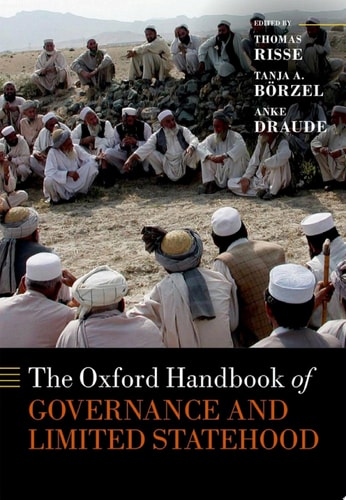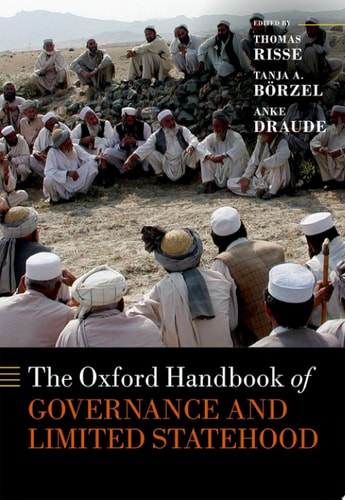
The Oxford Handbook of Governance and Limited Statehood
0
0
As an Amazon Associate and affiliate partner, Menrva Books earns from qualifying purchases. Learn more
Author Description
Unpacking the major debates, this Oxford Handbook brings together leading authors of the field to provide a state-of-the-art guide to governance in areas of limited statehood where state authorities lack the capacity to implement and enforce central decision and/or to uphold the monopoly over the means of violence. While areas of limited statehood can be found everywhere - not just in the Global South -, they are neither ungoverned nor ungovernable. Rather, a variety of actors maintain public order and safety, as well as provide public goods and services. While external state 'governors' and their interventions in the Global South have received special scholarly attention, various non-state actors - from NGOs to business to violent armed groups - have emerged that also engage in governance. This evidence holds for diverse policy fields and historical cases. The Handbook gives a comprehensive picture of the varieties of governance in areas of limited statehood from interdisciplinary perspectives including political science, geography, history, law, and economics. 29 chapters review the academic scholarship and explore the conditions of effective and legitimate governance in areas of limited statehood, as well as its implications for world politics in the twenty-first century. The authors examine theoretical and methodological approaches as well as historical and spatial dimensions of areas of limited statehood, and deal with the various governors as well as their modes of governance. They cover a variety of issue areas and explore the implications for the international legal order, for normative theory, and for policies toward areas of limited statehood.
Menrva's Summary
THE THESIS
This handbook investigates how governance functions in regions where state authorities lack the capacity to enforce central decisions or maintain a monopoly on the use of force. The editors, Anke Draude, Tanja A. Börzel, and Thomas Risse, curate contributions from leading scholars to analyze how public order and services are maintained in areas of limited statehood. By synthesizing interdisciplinary research, the text argues that these regions are not ungovernable, but rather rely on a complex array of state and non-state actors to provide essential public goods.
THE SCOPE MAP
What You Will Find
- Theoretical and methodological frameworks for analyzing governance in weak state environments
- Comparative analysis of non-state actors including NGOs, businesses, and armed groups
- Interdisciplinary perspectives spanning political science, geography, history, law, and economics
- Twenty-nine chapters covering diverse policy fields and historical case studies
Scope Limits
- Does not focus exclusively on the Global South, though it addresses external interventions there
- Does not provide a singular policy manual, but rather a review of academic scholarship and theoretical implications
THE AUTHORITY PERSPECTIVE
Experts identify this volume as a foundational reference for understanding the complexities of governance beyond traditional state-centric models. Readers frequently note the academic density of the prose, which makes it a primary resource for researchers and graduate-level students in international relations.
Page Count:
536
Publication Date:
2018-01-01
Publisher:
Oxford University Press
ISBN-10:
019251766X
ISBN-13:
9780192517661
Sociology
Public Policy
International relations
Governance
Global Studies