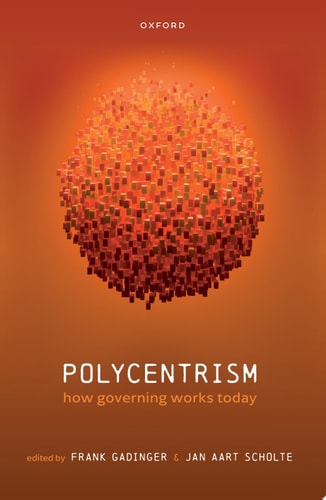
Polycentrism: How Governing Works Today
0
0
As an Amazon Associate and affiliate partner, Menrva Books earns from qualifying purchases. Learn more
Author Description
This is an open access title available under the terms of a CC BY-NC-ND 4.0 International licence. It is free to read at Oxford Academic and offered as a free PDF download from OUP and selected open access locations.How does governing work today? How does society (mis)handle pressing challenges such as armed violence, cultural difference, ecological degradation, economic restructuring, geopolitical shifts, global pandemics, migration flows, and technological change in ways that are (not) democratic, effective, fair, peaceful, and sustainable? This volume addresses these key questions with reference to the theme of 'polycentrism', i.e. the idea that contemporary governing is dispersed, fluctuating, messy, elusive, and headless. Chapters develop this notion of polycentrism from the perspectives of a broad spectrum of academic disciplines and theoretical approaches, offering comprehensive coverage of exciting new thinking about how today's world is (mis)ruled. The book identifies four paradigms of knowledge about polycentric governing - organizational, legal, relational, and structural - and pursues conversations across the divides that normally keep these approaches within separate research communities. These exceptional inter-paradigm exchanges focus particularly on issues of techniques (how governing is done), power (what forces drive governing), and legitimacy (whether governing is rightful). Comparisons between the multiple perspectives on polycentric governing highlight, and help to clarify, the distinctive emphases, potentials, and limitations of each approach. In addition, various combinations of the different theories generate promising novel avenues of thought about polycentrism. The book will allow readers to develop and refine their own understandings of governing today and hence to become more empowered political subjects.
Menrva's Summary
THE THESIS
This volume investigates how contemporary governance functions within a world characterized by dispersed, fluctuating, and headless authority structures. The authors, Frank Gadinger and Jan Aart Scholte, synthesize diverse academic perspectives to analyze how modern society manages complex global challenges such as ecological degradation, migration, and technological change. By identifying four distinct paradigms of knowledge—organizational, legal, relational, and structural—the text provides a framework for understanding the mechanisms of power, legitimacy, and technique in a polycentric world.
THE SCOPE MAP
What You Will Find
- A comprehensive analysis of four paradigms of polycentric governing: organizational, legal, relational, and structural.
- Theoretical exploration of how governing techniques, power dynamics, and legitimacy intersect in modern systems.
- Inter-paradigm exchanges that bridge divides between separate research communities.
Scope Limits
- The text does not provide a singular, unified theory of governance but rather a comparative analysis of multiple, often competing, theoretical approaches.
- It focuses on the conceptual framework of polycentrism rather than providing specific policy prescriptions for individual nation-states.
THE AUTHORITY PERSPECTIVE
Experts identify this work as a significant interdisciplinary contribution to the study of global governance and political theory. Readers frequently note the academic density of the prose, which serves as a foundational text for scholars and students examining the complexities of modern political authority.
Page Count:
416
Publication Date:
2023-08-25
Publisher:
Oxford University Press
ISBN-10:
0192866834
ISBN-13:
9780192866837
Public Administration
Public Policy
Governance
Sociology
International relations
Community Tags
Similar Books