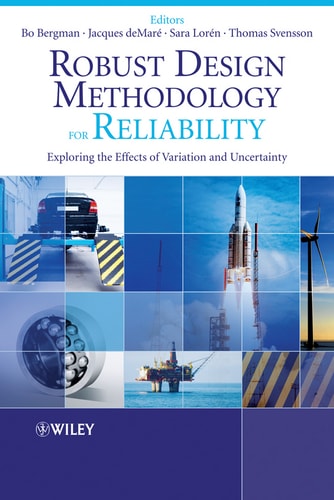
Robust Design Methodology for Reliability
0
0
As an Amazon Associate and affiliate partner, Menrva Books earns from qualifying purchases. Learn more
Author Description
Based on deep theoretical as well as practical experience in Reliability and Quality Sciences, Robust Design Methodology for Reliability constructively addresses practical reliability problems. It offers a comprehensive design theory for reliability, utilizing robust design methodology and six sigma frameworks. In particular, the relation between un-reliability and variation and uncertainty is explored and reliability improvement measures in early product development stages are suggested. Many companies today utilise design for Six Sigma (DfSS) for strategic improvement of the design process, but often without explicitly describing the reliability perspective; this book explains how reliability design can relate to and work with DfSS and illustrates this with real–world problems. The contributors advocate designing for robustness, i.e. insensitivity to variation in the early stages of product design development. Methods for rational treatment of uncertainties in model assumptions are also presented. This book promotes a new approach to reliability thinking that addresses the design process and proneness to failure in the design phase via sensitivity to variation and uncertainty; includes contributions from both academics and industry practitioners with a broad scope of expertise, including quality science, mathematical statistics and reliability engineering; takes the innovative approach of promoting the study of variation and uncertainty as a basis for reliability work; includes case studies and illustrative examples that translate the theory into practice. Robust Design Methodology for Reliability provides a starting point for new thinking in practical reliability improvement work that will appeal to advanced designers and reliability specialists in academia and industry including fatigue engineers, product development and process/ quality professionals, especially those interested in and/ or using the DfSS framework.
Menrva's Summary
THE THESIS
This book presents a comprehensive design theory for reliability, integrating robust design methodology and Six Sigma frameworks to address practical reliability challenges. Drawing on extensive theoretical and practical experience in Reliability and Quality Sciences, the book explores the relationship between unreliability, variation, and uncertainty. It offers suggestions for reliability improvement measures during early product development stages, specifically detailing how reliability design can align with and function within the Design for Six Sigma (DfSS) framework, supported by real-world problem illustrations.
THE SCOPE MAP
- A comprehensive design theory for reliability, utilizing robust design methodology and Six Sigma frameworks.
- Exploration of the relationship between un-reliability and variation and uncertainty.
- Suggestions for reliability improvement measures in early product development stages.
- Explanation of how reliability design relates to and works with Design for Six Sigma (DfSS).
- Illustrations of concepts with real-world problems.
- Methods for rational treatment of uncertainties in model assumptions.
- Case studies and illustrative examples that translate theory into practice.
THE AUTHORITY PERSPECTIVE
This book is positioned as a valuable resource for advanced designers and reliability specialists in both academia and industry, particularly those involved in product development, process/quality, and fatigue engineering, especially those utilizing the DfSS framework. The work's innovative approach lies in promoting the study of variation and uncertainty as a foundational element for reliability work. It advocates for designing for robustness, emphasizing insensitivity to variation in the early stages of product design. The contributions from academics and industry practitioners ensure a broad scope of expertise, covering quality science, mathematical statistics, and reliability engineering.
Page Count:
214
Publication Date:
2009-08-18
Publisher:
Wiley Global Research (STMS)
ISBN-10:
047074880X
ISBN-13:
9780470748800
Non-Fiction
Science & Technology
Engineering
Quality Control
Community Tags
Similar Books