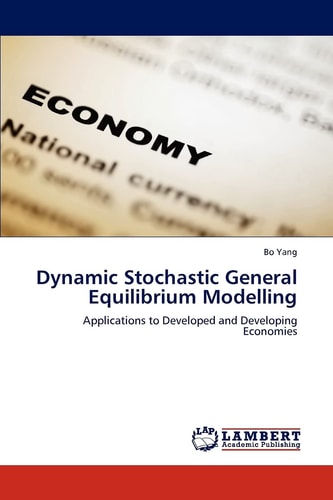
Dynamic Stochastic General Equilibrium Modelling
0
0
As an Amazon Associate and affiliate partner, Menrva Books earns from qualifying purchases. Learn more
Author Description
Recent episodes of financial turmoil have highlighted the need to understand how large external shocks are propagated in small open economies. This is particularly relevant in emerging economies, since these economies face additional vulnerabilities that make them very different from advanced economies. Indeed, they usually display weak fiscal, monetary and financial institutional frameworks, and have imperfect access to capital markets. This book studies Dynamic Stochastic General Equilibrium modelling and empirical applications to developed/developing economies. It consists of four self-contained chapters. Chapter 1 sets out a benchmark model with persistence mechanisms and reviews the underlying estimation/validation methods. Chapter 2 studies the relevance of direct supply side effects of monetary policy by introducing the presence of a cost channel of monetary transmission and allowing for non-separability of money and consumption in the household's utility. Chapters 3 and 4 model dollarization, as well as financial frictions including a 'financial accelerator', where capital financing is partly or totally in foreign currency as in Gertler et al. (2003) and Gilchrist (2003).
Menrva's Summary
THE THESIS
This book investigates the propagation of external shocks in small open economies, with a particular focus on emerging economies. It examines Dynamic Stochastic General Equilibrium (DSGE) modelling and its empirical applications to both developed and developing economies. The author, Bo De Yang, draws on recent financial turmoil to highlight the need for robust models that account for the unique vulnerabilities of emerging markets, such as weak institutional frameworks and imperfect capital market access. The book presents four self-contained chapters that build upon a benchmark model, introducing complexities like monetary policy transmission channels and financial frictions.
THE SCOPE MAP
- A benchmark DSGE model with persistence mechanisms and its estimation/validation methods.
- Analysis of the direct supply-side effects of monetary policy through a cost channel and non-separable money-consumption utility.
- Modeling of dollarization in emerging economies.
- Incorporation of financial frictions, including a 'financial accelerator' mechanism with foreign currency financing.
THE AUTHORITY PERSPECTIVE
This book offers a detailed exploration of Dynamic Stochastic General Equilibrium modelling, particularly relevant for understanding economic shocks in emerging markets. The structure, with its four self-contained chapters, allows for a focused examination of complex economic phenomena. The inclusion of monetary policy transmission channels and financial accelerator models suggests a rigorous approach to contemporary macroeconomic challenges. The work is positioned to be of interest to academics and policymakers concerned with the financial stability of developing economies.
Page Count:
280
Publication Date:
2011-09-01
Publisher:
Lap Lambert Academic Publishing GmbH KG
ISBN-10:
3845431016
ISBN-13:
9783845431017
Economics
Non-Fiction
Econometrics
Macroeconomics
Finance
Community Tags
Similar Books