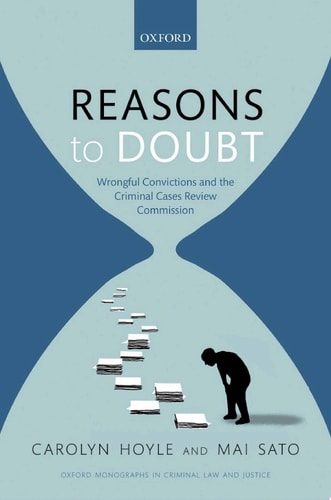
Reasons to Doubt: Wrongful Convictions and the Criminal Cases Review Commission
0
0
As an Amazon Associate and affiliate partner, Menrva Books earns from qualifying purchases. Learn more
Author Description
This book reveals what happens to applications for post-conviction review when those in England, Wales, and Northern Ireland who believe they are wrongfully convicted apply to the Criminal Cases Review Commission, the only body that can refer a case back to the Court of Appeal once appellants opportunities for direct appeal are exhausted. While the Court is obliged to hear all such referrals, the Commission can only refer a case where it believes there is a real possibility that the Court will quash the conviction. The first empirical study of all stages of decision-making within the Commission, this book starts from the premise that the test applied by the Commission (the real possibility test) is not inflexible. Though created by statute and refined through case law, it must be determined on a case-by-case basis, drawing too on cultural and structural variables, alongside fresh evidence gathered by the Commission. Through in-depth analysis of case files and interviews, Hoyle and Sato scrutinize the Commissions operational practices, its working rules and assumptions, considering how these influence its understanding of the real possibility test. Situating their rich empirical data within a framework of the Commissions social, organizational, and legal contexts, this book demonstrates that in its open-ended investigations there is considerable scope for discretion; for thorough exploration of all possible avenues or for choosing a more superficial consideration of a case. It emerges that while structured internal guidance, drawing heavily on Court jurisprudence, shapes decision-making, creating consistency in approach, there remains some variability across cases, over time, that can be accounted for by the different professional backgrounds and personalities of Commission staff.
Menrva's Summary
THE THESIS
This book investigates the operational decision-making processes of the Criminal Cases Review Commission (CCRC) to determine how the 'real possibility' test is applied in cases of alleged wrongful conviction. Carolyn Hoyle and Mai Sato, both established scholars in criminology and criminal law, utilize a comprehensive empirical framework to analyze the internal mechanics of the CCRC. By examining the intersection of statutory requirements, organizational culture, and individual staff discretion, the authors argue that the application of legal standards is significantly influenced by the professional backgrounds and institutional environment of the decision-makers.
THE SCOPE MAP
What You Will Find
- Empirical analysis of decision-making stages within the Criminal Cases Review Commission.
- Examination of the 'real possibility' test as applied in England, Wales, and Northern Ireland.
- Qualitative data derived from in-depth interviews with Commission staff and review of internal case files.
Scope Limits
- The study is geographically restricted to the jurisdictions of England, Wales, and Northern Ireland.
- The research focuses specifically on the CCRC and does not provide a comparative analysis of post-conviction review bodies in other international jurisdictions.
THE AUTHORITY PERSPECTIVE
Legal scholars and practitioners recognize this work as a definitive empirical study of the CCRC's internal operations. Readers frequently note the academic density of the prose, which provides a rigorous examination of how discretion functions within a structured legal framework.
Page Count:
405
Publication Date:
2019-01-01
Publisher:
OUP Oxford
ISBN-10:
0192513435
ISBN-13:
9780192513434
Non-Fiction
Law
Criminology
Professional Career & Trade
Legal Studies
Community Tags
Similar Books