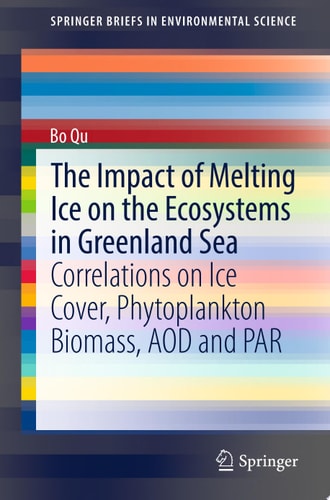
The Impact of Melting Ice on the Ecosystems in Greenland Sea
0
0
As an Amazon Associate and affiliate partner, Menrva Books earns from qualifying purchases. Learn more
Author Description
Arctic marine ecosystems are largely impacted by changes associated with global warming. The sea ice in Greenland Sea plays an important role in regional and global climate system. The book investigate the relationships between phytoplankton biomass, measured using remotely sensed chlorophyll-a (CHL), aerosol optical depth (AOD) and sea-ice cover (ICE) in the Greenland Sea (20°W-10°E, 65-85°N) over the period 2003-2012. First hand Satellite data was used to do correlation analysis. Enhanced statistics methods, such as lag regression method and cointegration analysis method are used for correlation and regression analysis between 2 variables (up to 3 variables). ARMA model was used to prediction time series in the future 3 years. The book not only gives outline of ecosystem in Greenland Sea, how the ice impact to the local ecosystems, but also provides valuable statistical methods on analysis correlations and predicting the future ecosystems.
Menrva's Summary
THE THESIS
This book investigates the intricate relationships between sea ice cover, phytoplankton biomass, and atmospheric conditions in the Greenland Sea, focusing on the period between 2003 and 2012. The author, Bo Qu, utilizes satellite data to analyze how changes in sea ice, a critical component of the Arctic climate system, influence regional ecosystems. The study employs advanced statistical methods, including lag regression and cointegration analysis, to establish correlations and predict future trends in phytoplankton biomass, measured via remotely sensed chlorophyll-a. The research aims to provide a comprehensive overview of the Greenland Sea's ecosystem and the impact of melting ice, offering valuable insights into analytical and predictive methodologies for environmental science.
THE SCOPE MAP
- Analysis of the impact of global warming on Arctic marine ecosystems.
- Focus on the role of sea ice in the Greenland Sea's climate system.
- Investigation of relationships between phytoplankton biomass (chlorophyll-a), aerosol optical depth, and sea-ice cover (2003-2012).
- Utilization of first-hand satellite data for correlation analysis.
- Application of enhanced statistical methods: lag regression and cointegration analysis.
- Prediction of future ecosystem trends using the ARMA model for a 3-year forecast.
- Detailed outline of the Greenland Sea ecosystem and ice impact.
- Presentation of statistical methods for correlation and prediction.
THE AUTHORITY PERSPECTIVE
The book presents a data-driven analysis of the Greenland Sea's ecosystem, focusing on the quantifiable impacts of melting ice. Its methodology, employing satellite data and advanced statistical techniques like lag regression and cointegration, suggests a rigorous approach to environmental science research. The inclusion of time-series prediction using the ARMA model indicates a forward-looking perspective on ecosystem dynamics. The work is positioned to offer both a regional ecological overview and practical statistical tools for researchers in the field.
Page Count:
86
Publication Date:
2014-10-09
Publisher:
Springer Nature
ISBN-10:
3642544983
ISBN-13:
9783642544989
Science
Non-Fiction
Data Analysis
Climate Change
Ecology
Community Tags
Similar Books