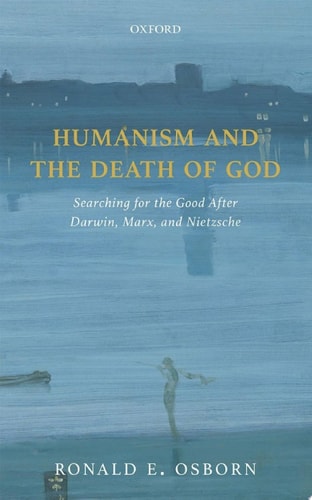
Humanism and the Death of God: Searching for the Good After Darwin, Marx, and Nietzsche
0
0
As an Amazon Associate and affiliate partner, Menrva Books earns from qualifying purchases. Learn more
Author Description
Humanism and the Death of God is a critical exploration of secular humanism and its discontents. Through close readings of three exemplary nineteenth-century philosophical naturalists or materialists, who perhaps more than anyone set the stage for our contemporary quandaries when it comes to questions of human nature and moral obligation, Ronald E. Osborn argues that "the death of God" ultimately tends toward the death of liberal understandings of the human as well. Any fully persuasive defense of humanistic values--including the core humanistic concepts of inviolable dignity, rights, and equality attaching to each individual--requires an essentially religious vision of personhood. Osborn shows such a vision is found in an especially dramatic and historically consequential way in the scandalous particularity of the Christian narrative of God becoming a human. He does not attempt to provide logical proofs for the central claims of Christian humanism along the lines some philosophers might demand. Instead, this study demonstrates how philosophical naturalism or materialism, and secular humanisms and anti-humanisms, might be persuasively read from the perspective of a classically orthodox Christian faith.
Menrva's Summary
THE THESIS
Does the rejection of the divine in secular humanism inevitably lead to the erosion of the concepts of human dignity, rights, and equality? Ronald E. Osborn, a scholar of theology and history, examines the intellectual legacy of Charles Darwin, Karl Marx, and Friedrich Nietzsche to argue that secular materialism struggles to ground moral obligation. He posits that the liberal understanding of the individual requires a religious framework, specifically the Christian narrative of the incarnation, to maintain its foundational values.
THE SCOPE MAP
What You Will Find
- Critical analysis of nineteenth-century philosophical naturalism and materialism
- Comparative study of the works of Darwin, Marx, and Nietzsche
- Theological defense of human dignity through the lens of orthodox Christian faith
- Examination of the tension between secular humanism and anti-humanist thought
Scope Limits
- The text does not provide formal logical proofs for Christian claims in the style of analytic philosophy
- It does not offer an exhaustive history of all secular humanist movements
THE AUTHORITY PERSPECTIVE
Scholars and readers note that the text provides a rigorous challenge to secular assumptions regarding human rights. Experts highlight this as a significant contribution to contemporary debates on the intersection of theology and political philosophy.
Page Count:
240
Publication Date:
2017-01-01
Publisher:
OUP Oxford
ISBN-10:
0192510991
ISBN-13:
9780192510990
Religion
Philosophy
Humanism
Theology
Ethics
Christianity
Intellectual History
Community Tags
Similar Books