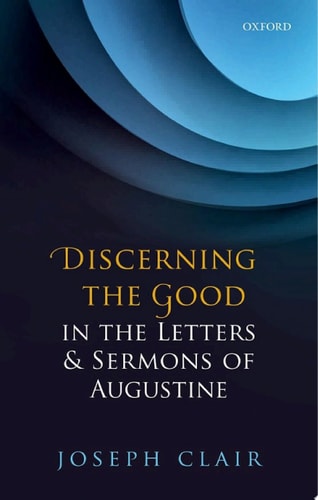
Discerning the Good in the Letters and Sermons of Augustine
0
0
As an Amazon Associate and affiliate partner, Menrva Books earns from qualifying purchases. Learn more
Author Description
Discerning the Good in the Letters and Sermons of Augustine turns to the vast collection of moral advice found in Augustine's letters and sermons, mining these neglected and highly illuminating texts for examples of Augustine's application of his own moral concepts. It focuses on letters and sermons in which Augustine offers concrete advice on how to interact with the various goods relevant to social and political life. A special set of goods reappears throughout the letters and sermons, namely sexual intimacy and domestic life, power and public office, and wealth and private possessions. Together, these goods form the central topics of this book. Joseph Clair highlights that the most revealing cases are those in which an individual must choose between competing goods, and cases in which an individual's role and role--specific obligations inform their decisions. Such cases uncover the nimbleness of Augustine's moral reasoning in action--an artful blend of scriptural interpretation, virtue theory, and sensitivity to the circumstances of individual lives. He reveals that Augustine's understanding of the goods constitutive of social and political life is deeply indebted to the Stoic and Peripatetic doctrine of oikeiōsis, or "social appropriation". The colorful, personal, and practical details found in these writings provide a window onto Augustine's moral reasoning not available in his more theoretical treatments of the good, and the concrete cases often illustrate the human significance of properly discerning the good. Beyond providing one of the first analyses of these ethical writings, this work contributes a new sense of Augustine's ethics--both in terms of the range of questions he addresses and the manner in which he treats them.
Menrva's Summary
THE THESIS
This work investigates how Augustine of Hippo applied his moral philosophy to the practical challenges of social and political life through his correspondence and sermons. Joseph Clair, a scholar of ethics and historical theology, examines these often-overlooked texts to demonstrate how Augustine navigated complex moral dilemmas. By analyzing specific instances where individuals faced competing obligations, Clair argues that Augustine’s moral reasoning was a sophisticated integration of scriptural interpretation, virtue theory, and the Stoic concept of oikeiōsis.
THE SCOPE MAP
What You Will Find
- Analysis of Augustine's moral advice regarding sexual intimacy, domestic life, power, and wealth.
- Application of the Stoic and Peripatetic doctrine of social appropriation to Augustinian ethics.
- Examination of role-specific obligations in moral decision-making.
Scope Limits
- The study does not provide a comprehensive survey of Augustine's entire corpus of letters and sermons.
- The book does not focus on Augustine's theoretical treatises on the nature of the good, prioritizing practical application instead.
THE AUTHORITY PERSPECTIVE
Scholars recognize this text as a significant contribution to the study of Augustinian ethics, particularly for its focus on the practical application of his moral concepts. Readers frequently note the academic density of the prose, which is intended for those with a background in philosophy or theology.
Page Count:
204
Publication Date:
2016-01-01
Publisher:
OUP Oxford
ISBN-10:
0191075221
ISBN-13:
9780191075223
Religion
History
Philosophy
Augustine of Hippo
Christianity
Ethics
Theology
Community Tags
Similar Books