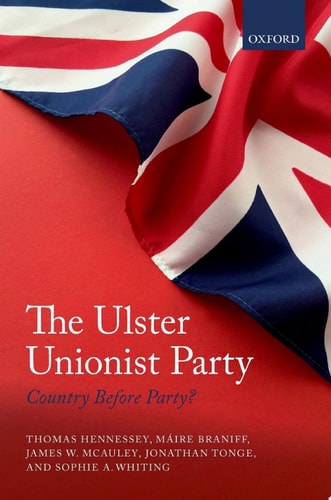
The Ulster Unionist Party: Country Before Party?
0
0
As an Amazon Associate and affiliate partner, Menrva Books earns from qualifying purchases. Learn more
Author Description
The Ulster Unionist Party: Country Before Party? uses unprecedented access to the party that dominated Northern Ireland politics for decades to assess the reasons for its decline and to analyse whether it can recover. Having helped produce the Belfast/Good Friday Agreement, the Ulster Unionist Party (UUP) struggled to deliver the deal amid unease over aspects of what its leadership negotiated. Paramilitary prisoner releases, policing changes, and power-sharing with the republican 'enemy' were all controversial. As the UUP leader won a Nobel Peace Prize, his party began to lost elections. For the UUP leadership, acceptance of change was the right thing to do for Northern Ireland - a case of putting country before party. The decades since the peace agreement have seen the UUP eclipsed by the rival Democratic Unionist Party (DUP) even though most of what the UUP agreed in 1998 has remained in place. This book examines the travails of the UUP in recent times. It draws upon the first-ever survey of UUP members and a wide range of interviews, including with the five most recent leaders of the party, to analyse the reasons for its reverses and the capacity to revive. The volume assesses why the UUP's (still sizeable) membership remains loyal and discusses what the UUP and unionism means to those members, in terms of loyalty, policy, national and religious identity, views of other parties and what a shared future in Northern Ireland will constitute. Amid Brexit and talk of a border poll, crises of devolved government, rows with republicans and intra-unionist tensions, how secure and confident does the UUP membership feel about Northern Ireland's future? Written by the same expert team that produced an award-winning book on the DUP, this book is indispensable to understanding parties and political change in divided societies.
Menrva's Summary
THE THESIS
This book investigates the factors contributing to the decline of the Ulster Unionist Party (UUP) following its pivotal role in the Belfast/Good Friday Agreement and evaluates its potential for future political recovery. The authors, a team of distinguished academics specializing in Northern Irish politics, utilize a combination of original survey data and high-level interviews to construct a comprehensive analysis of the party's internal dynamics and external electoral challenges. They argue that the party's commitment to the peace process, while historically significant, created a disconnect between leadership decisions and the broader unionist electorate, leading to its displacement by the Democratic Unionist Party.
THE SCOPE MAP
What You Will Find
- Analysis of the UUP's electoral performance from the 1998 Good Friday Agreement to the present.
- Findings from the first-ever comprehensive survey of UUP party members.
- Qualitative data derived from interviews with the five most recent UUP party leaders.
- Examination of identity, loyalty, and policy alignment within the contemporary unionist movement.
Scope Limits
- The text does not provide a general history of Northern Ireland prior to the late 20th century.
- It does not offer a predictive model for future election outcomes beyond analyzing current party capacity.
THE AUTHORITY PERSPECTIVE
Experts recognize this volume as a definitive study on the UUP, noting the high level of access the authors secured for their research. Readers frequently highlight the academic rigor and the clarity with which the authors navigate the complexities of post-conflict political transitions.
Page Count:
250
Publication Date:
2018-01-01
Publisher:
OUP Oxford
ISBN-10:
0192513192
ISBN-13:
9780192513199
History
British Politics
Northern Ireland
Community Tags
Other Editions(2)
Similar Books






Reader Comments
Share Your Thoughts
No comments yet. Be the first to share your thoughts!