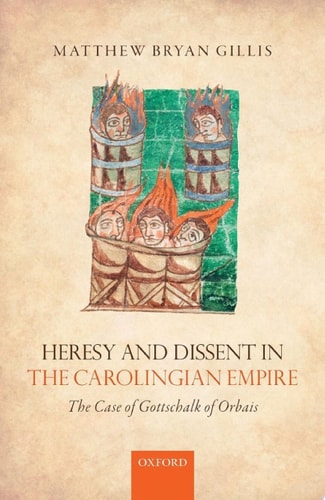
Heresy and Dissent in the Carolingian Empire: The Case of Gottschalk of Orbais
0
0
As an Amazon Associate and affiliate partner, Menrva Books earns from qualifying purchases. Learn more
Author Description
Heresy and Dissent in the Carolingian Empire recounts the history of an exceptional ninth-century religious outlaw, Gottschalk of Orbais. Frankish Christianity required obedience to ecclesiastical superiors, voluntary participation in reform, and the belief that salvation was possible for all baptized believers. Yet Gottschalk-a mere priest-developed a controversial, Augustinian-based theology of predestination, claiming that only divine election through grace enabled eternal life. Gottschalk preached to Christians within the Frankish empire-including bishops-and non-Christians beyond its borders, scandalously demanding they confess his doctrine or be revealed as wicked reprobates. Even after his condemnations for heresy in the late 840s, Gottschalk continued his activities from prison thanks to monks who smuggled his pamphlets to a subterranean community of supporters. This study reconstructs the career of the Carolingian Empire's foremost religious dissenter in order to imagine that empire from the perspective of someone who worked to subvert its most fundamental beliefs. Examining the surviving evidence (including his own writings), Matthew Gillis analyzes Gottschalk's literary and spiritual self-representations, his modes of argument, his prophetic claims to martyrdom and miraculous powers, and his shocking defiance to bishops as strategies for influencing contemporaries in changing political circumstances. In the larger history of medieval heresy and dissent, Gottschalk's case reveals how the Carolingian Empire preserved order within the church through coercive reform. The hierarchy compelled Christians to accept correction of perceived sins and errors, while punishing as sources of spiritual corruption those rare dissenters who resisted its authority.
Menrva's Summary
THE THESIS
This study investigates how the ninth-century priest Gottschalk of Orbais challenged the religious and political orthodoxy of the Carolingian Empire through his controversial theology of predestination. Matthew Bryan Gillis, a scholar of medieval history, utilizes surviving primary sources and Gottschalk's own writings to examine the intersection of dissent, ecclesiastical authority, and coercive reform. The author argues that Gottschalk’s career serves as a lens through which to view the mechanisms of power and the management of religious nonconformity within the Frankish church.
THE SCOPE MAP
What You Will Find
- Analysis of ninth-century Carolingian religious reform and ecclesiastical hierarchy
- Examination of Gottschalk of Orbais’s theological arguments regarding predestination
- Study of clandestine communication networks and the smuggling of prohibited texts
- Investigation into the strategies of self-representation, martyrdom, and prophetic claims
Scope Limits
- The study focuses primarily on the specific case of Gottschalk rather than a comprehensive history of all Carolingian heresies
- The analysis is limited by the surviving manuscript evidence and the perspective of the institutional records that condemned him
THE AUTHORITY PERSPECTIVE
Scholars recognize this work as a detailed reconstruction of medieval dissent that effectively challenges traditional narratives of Carolingian religious uniformity. Readers frequently note the academic rigor of the prose and the author's ability to contextualize complex theological disputes within the broader political framework of the ninth century.
Page Count:
287
Publication Date:
2017-01-01
Publisher:
OUP Oxford
ISBN-10:
0192518283
ISBN-13:
9780192518286
Biography
History
Carolingians
Religious History
Theology
European History
Carolingian Empire
Community Tags
Similar Books