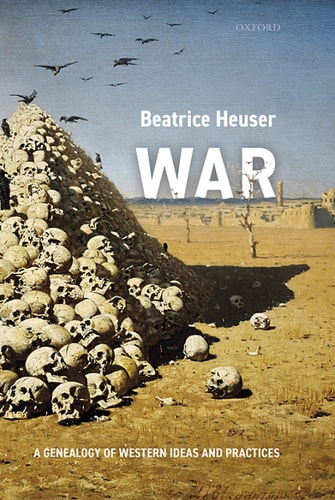
War: A Genealogy of Western Ideas and Practices
0
0
As an Amazon Associate and affiliate partner, Menrva Books earns from qualifying purchases. Learn more
Author Description
War has been conceptualised from a military perspective, but also from ethical, legal, and philosophical viewpoints. These different analytical perspectives are all necessary to understand the many dimensions war, the continua on which war is situated - from small-scale to large-scale, from limited in time or long, from less to extremely destructive, with varying aims, and degrees of involvement of populations. Western civilisations have conceptualised war in binary ways denying the variety of manifestations of war along these continua. While binary definitions are necessary to capture different conditions legally, they hamper analysis. The binaries include inter-State and intestine war, just war and unjust war (the latter including insurgencies), citizen-soldiers and professionals, civilians and combatants. Yet realities have mostly straddled such demarcations. Even citizen-armies have usually included professionals, civilians have been treated as enemies and sometimes even formally defined as enemies, and rules have not conformed with binary distinctions, if they were respected at all. While customary rules governing the conduct of war have been turned into International Law, this is the only aspect of war that has developed in a fairly linear way, while the rise, disappearance, and renaissance of the just war tradition has been anything but linear. This non-linearity also applies to the brutality with which war has been fought, especially towards civilians, who for long stretches of European history must have been the main victims of war, notwithstanding increasing protection they were afforded in theory by customary law. To understand war, we must shed some of these binaries.
Menrva's Summary
THE THESIS
This work investigates the historical evolution of Western conceptualizations of war, arguing that rigid binary frameworks have historically obscured the complex, non-linear realities of armed conflict. Beatrice Heuser, a distinguished scholar in international relations and military history, utilizes a broad historical survey of European thought to challenge traditional dichotomies such as just versus unjust war, and combatant versus civilian. Her primary argument posits that these binary classifications, while legally convenient, fail to capture the nuanced, often brutal reality of how war has been practiced throughout history.
THE SCOPE MAP
What You Will Find
- A comprehensive analysis of the evolution of the 'just war' tradition from antiquity to the modern era.
- An examination of the historical treatment of civilians and the development of customary laws of war.
- A critique of binary legal and philosophical distinctions in military theory.
Scope Limits
- The analysis is primarily restricted to the development of Western ideas and practices.
- The text does not provide a detailed tactical or operational history of specific battles.
THE AUTHORITY PERSPECTIVE
Experts recognize this text as a significant contribution to the intellectual history of warfare, noting its ability to synthesize complex philosophical and legal shifts. Readers frequently highlight the academic density of the prose, which serves as a rigorous examination for students and scholars of political theory.
Page Count:
449
Publication Date:
2022-01-01
Publisher:
OUP Oxford
ISBN-10:
0192517198
ISBN-13:
9780192517197
Philosophy
History
War Studies
International relations
Military History
Community Tags
Similar Books