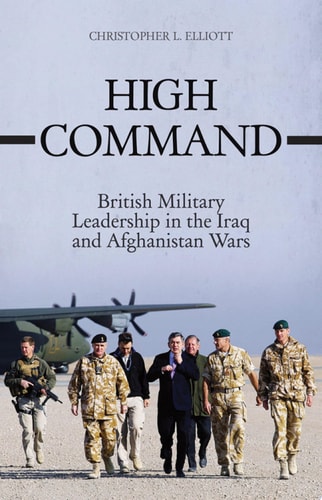
High Command: British Military Leadership in the Iraq and Afghanistan Wars
0
0
As an Amazon Associate and affiliate partner, Menrva Books earns from qualifying purchases. Learn more
Author Description
From 2001, Britain supported the United States in wars in Iraq and Afghanistan. "Victory" in such conflicts is always hard to gauge and domestic political backing for them was never robust. For this, the governments of Tony Blair and Gordon Brown were held responsible, and paid the price, but the role played by the High Command in the Ministry of Defence also bears examination. Critics have noted that the armed services were riven by internal rivalry and their leadership was dysfunctional, but the truth is more complicated.In his book, General Elliott explores the circumstances that led to these wars and how the Ministry of Defence coped with the challenges presented. He reveals how the Service Chiefs were set at odds by the system, almost as rivals in the making, with responsibility diffuse and authority ambiguous. The MoD concentrated on making things work, rather than questioning whether what they were being asked to do was practicable. Often the opinion of a junior tactical commander led the entire strategy of the MoD, not the other way around, as it should have been. While Britain's senior officers, defense ministers and civil servants were undeniably competent and well intentioned, the conundrum remains why success on the battlefield proved so elusive.
Menrva's Summary
THE THESIS
This book investigates the systemic failures and structural ambiguities within the British Ministry of Defence that hindered strategic success during the Iraq and Afghanistan conflicts. General Christopher Elliott, a retired British Army officer, utilizes his professional background and access to military discourse to analyze the disconnect between political objectives and military execution. He argues that the organizational structure of the High Command fostered internal rivalry and diffused responsibility, ultimately preventing a coherent strategic approach to these protracted wars.
THE SCOPE MAP
What You Will Find
- Analysis of the decision-making processes within the Ministry of Defence from 2001 onwards.
- Examination of the structural tensions between the Service Chiefs and civil servants.
- Case studies regarding the operational challenges faced in Iraq and Afghanistan.
Scope Limits
- The text does not provide a comprehensive tactical history of every battle fought in these theaters.
- It does not focus on the personal biographies of the political leaders involved, but rather on the institutional mechanisms of the military command.
THE AUTHORITY PERSPECTIVE
Experts and military historians recognize this work as a critical internal critique of the British defense establishment's structural shortcomings. Readers frequently note the author's unique perspective as a former insider, which provides a level of institutional detail rarely found in broader political accounts of these conflicts.
Page Count:
274
Publication Date:
2014-01-01
Publisher:
Oxford University Press
ISBN-10:
0190257423
ISBN-13:
9780190257422
History
British History
Great Britain
Military History
War Studies
International relations
Community Tags
Similar Books