Why Isn't Government Policy More Preventive?
0
0
As an Amazon Associate and affiliate partner, Menrva Books earns from qualifying purchases. Learn more
Author Description
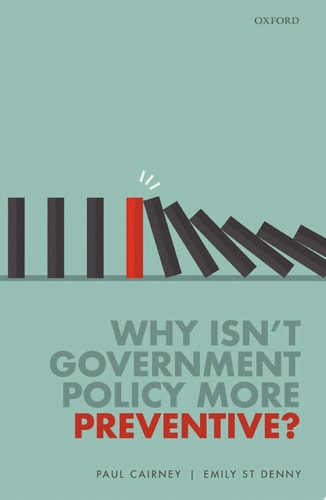
If 'prevention is better than cure', why isn't policy more preventive? Policymakers only have the ability to pay attention to, and influence, a tiny proportion of their responsibilities, and they engage in a policymaking environment of which they have limited understanding and even less control. This simple insight helps explain the gap between stated policymaker expectations and actual policy outcomes. Why Isn't Government Policy more Preventive? uses these insights to produce new empirical studies of 'wicked' problems with practical lessons. The authors find that the UK and Scottish governments both use a simple idiom - prevention is better than cure - to sell a package of profound changes to policy and policymaking. Taken at face value, this focus on 'prevention' policy seems like an idea 'whose time has come'. Yet, 'prevention' is too ambiguous until governments give it meaning. No government has found a way to turn this vague aim into a set of detailed, consistent, and defendable policies. This book examines what happens when governments make commitments without knowing how to deliver them. It compares their policymaking contexts, roles and responsibilities, policy styles, language, commitments, and outcomes in several cross-cutting policy areas (including health, families, justice, and employability) to make sense of their experiences. The book uses multiple insights from policy theory to help research and analyse the results. The results help policymakers reflect on how to avoid a cycle of optimism and despair when trying to solve problems that their predecessors did not.
Menrva's Summary
THE THESIS
This book investigates why governments struggle to implement preventive policies despite the widespread political rhetoric that prevention is superior to reactive measures. Paul Cairney and Emily St Denny utilize theories of bounded rationality and policy complexity to argue that the gap between political ambition and actual outcomes stems from the inherent limitations of policymaking environments, where attention is scarce and control is minimal.
THE SCOPE MAP
What You Will Find
- Comparative analysis of UK and Scottish government policy frameworks
- Application of policy theory to complex social issues
- Empirical studies across health, family, justice, and employability sectors
Scope Limits
- The analysis does not provide a universal blueprint for successful preventive policy implementation
- The study does not cover non-Western political systems or local municipal governance structures
THE AUTHORITY PERSPECTIVE
Experts recognize this work as a significant contribution to the study of policy implementation and the limitations of political rhetoric. Readers frequently note the academic density of the prose, which serves as a rigorous resource for students and practitioners of public administration.
Page Count:
302
Publication Date:
2020-01-01
Publisher:
OUP Oxford
ISBN-10:
0192511785
ISBN-13:
9780192511782
Public Administration
Social policy
Government
Public Policy
Community Tags
Similar Books