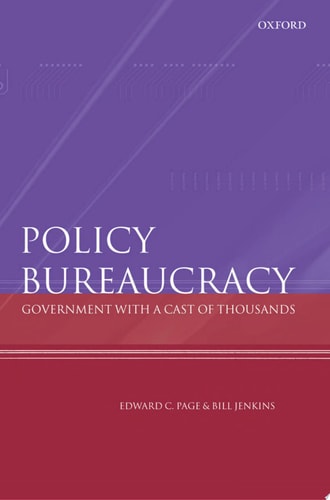
Policy Bureaucracy: Government with a Cast of Thousands
0
0
As an Amazon Associate and affiliate partner, Menrva Books earns from qualifying purchases. Learn more
Author Description
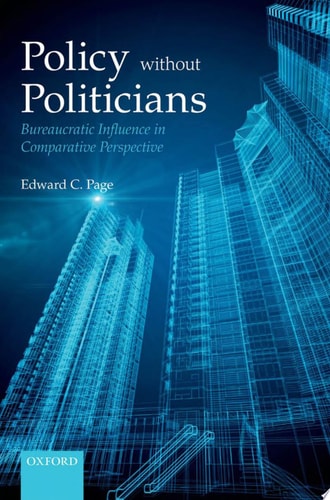
Policy making is not only about the cut and thrust of politics. It is also a bureaucratic activity. Long before laws are drafted, policy commitments made, or groups consulted on government proposals, officials will have been working away to shape the policy into a form in which it can be presented to ministers and the outside world. Policy bureaucracies - parts of government organizations with specific responsibility for maintaining and developing policy - have to be mobilized before most significant policy initiatives are launched. This book describes the range of work policy officials do. The 140 civil servants interviewed for this study included officials who helped originate policies which were subsequently taken over as manifesto commitments by the Labour Party; officials who helped devise the formula by which billions of pounds are allocated to local government in grants; and also officials who recommended to the Secretary of State that a controversial publisher be allowed to take over a national newspaper. The background and career paths of middle-ranking officials show them to be a diverse group who do not tend to develop long-term subject specialisms. The instructions to which these officials work - whether coming from ministers or senior officials - are often very broad and leave much to personal interpretation. Policy Bureaucracy goes on to examine how ministers and senior officials affect the work of middle ranking officials and the cues policy bureaucrats use to develop policy. The analytical approach adopted in the book is derived from Alvin Gouldner's Patterns of Industrial Bureaucracy and his elaboration of Max Weber's notion that hierarchy and expertise place a fundamental tension at the heart of modern bureaucracies. In the UK this tension is handled by combining 'invited authority' with 'improvised expertise'. The book also explores other models of handling this tension in political systems in Europe and the USA.
Menrva's Summary
THE THESIS
This book investigates the internal mechanisms of policy bureaucracies and how civil servants shape government initiatives before they reach the political stage. The authors, Bill Jenkins and Edward C. Page, utilize empirical data from interviews with 140 UK civil servants to analyze the professional behaviors and career trajectories of middle-ranking officials. They argue that the tension between hierarchy and expertise, as theorized by Max Weber and Alvin Gouldner, defines the operational reality of modern government policy development.
THE SCOPE MAP
What You Will Find
- Analysis of the career paths and backgrounds of middle-ranking civil servants.
- Examination of how ministers and senior officials influence policy development.
- Comparative study of bureaucratic models in the UK, Europe, and the USA.
- Application of Gouldner's 'Patterns of Industrial Bureaucracy' framework.
Scope Limits
- The study focuses primarily on the UK civil service, with limited comparative depth for non-Western political systems.
- It does not provide a comprehensive history of specific legislative acts, focusing instead on the bureaucratic process behind them.
THE AUTHORITY PERSPECTIVE
Experts recognize this work as a significant contribution to the study of public administration and the internal dynamics of the civil service. Readers frequently note the academic density of the prose, which serves as a foundational text for understanding the practical realities of policy-making bureaucracies.
Page Count:
240
Publication Date:
2005-01-01
Publisher:
Oxford University Press
ISBN-10:
0191515612
ISBN-13:
9780191515613
Bureaucracy
Government
Public Policy
Public Administration
Community Tags
Similar Books